German Awards - Service Award 2nd Class
Awards for service in the Wehrmacht were established on March 16, 1936 on the occasion of the first anniversary of the restoration of universal military duty by Reich Chancellor Adolf Hitler. Initially consisted of 4 classes. 1st and 2nd grades - crosses, 3rd and 4th - medals. On 10 March 1939, oak leaves for 1st class were donated after 40 years of service. During the service, periods spent in the old Wehrmacht and in recognized volunteer associations (Freikorps) before moving to the Reichswehr and then to the Wehrmacht were also counted. Breaks were not counted. In addition, periods of service in the land and security police could be counted if the person was transferred to the Wehrmacht.
All Wehrmacht servicemen who served in the Wehrmacht on March 16, 1935 or later had the right to admission. Since May 3, 1939, service awards could also be awarded to former servicemen of the Austrian Wehrmacht. Similar rules were in effect until 1935.
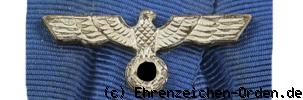
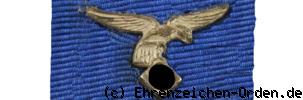
The army and navy have the Wehrmacht emblem of the corresponding class color on the ribbon. The Air Force carries the Air Force emblem of the corresponding class color on the ribbon.
A cross made of silver-plated tombac or zinc. Cross arms with enlarged triple line. The inner sides of the crosses are smooth. Front and rear with a round central shield. On the upper cruciform shoulder, a slightly stronger ear with a ribbon ring is soldered.
Front side:
- Central shield with raised smooth edge.
- On a grainy field there is a high eagle with lowered wings.
In - catches, he holds a swastika placed on top.
Downside:
- Central shield with raised smooth edge.
- On the marked field number - 18 -.
Tape:
blue 35 mm wide. Army and Navy.
blue 35 mm wide. Air Force circulation.
Photos of www.militaria-berlin.de
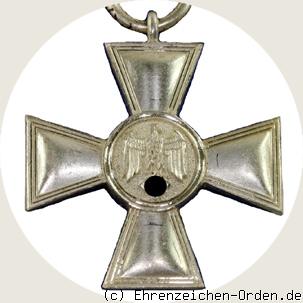 Front: Service Award 2 Class
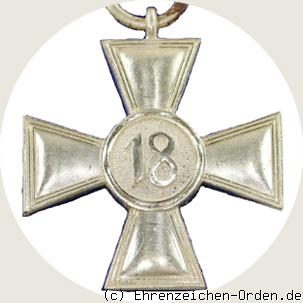 Downside: Service Award 2.Class
Established:
March 16, 1936 Adolf Hitler
Data:
- Material: silver-plated zinc
- Size: 36mm
- Weight: About 15g
estimated collector price:
150 - 160 € silver plated in Tombac
110 - 120 € silver plated in zinc and iron

 Awards of World War II