German Awards - Order of Merit from Mikhailovsky Breast Star to Grand Cross
King Ludwig I established the Order of Merit of St. Michael on February 16, 1837. The motto of the order is "Principi Fidelis Favere Patriae" ("Loyal to the Prince Serving the Fatherland") The order first consisted of 3 classes: the Grand Cross, Komtur and Knight. The prerequisite was excellent useful service in various fields, devotion and love for the homeland, which were supposed to cause the satisfaction of the king. Maximilian II. expanded the order at the expense of gross-komture, dividing the knights into 1st and 2nd. Class before the new classification came into effect in 1887. The unit was: Grand Cross, 1st Class, 2nd Class with Star, 2nd Class, 3rd Class, 4th Class with Crown, Cross of Merit and Silver Medal of Merit. In 1894, a bronze medal was added. The last expansion and division occurred in 1910. 4th grade and the cross "For Merit" could now be awarded with and without a crown.
The size of the pectoral stars of the large cross varies from 86 to 110 mm, depending on the manufacturer. The pectoral stars identical in design to the cross of the 1st class differ mainly in size (75 mm). Notable manufacturers are Gebrüder Hemmerle - Munich, Lemaitre - Paris and Eduard Quelhorst - Munich. Early stars also wear moose as a sire. Until the early 1850s, chest stars were embroidered. At the end of the world war, the gold crosses were made of silver.
The Order of St. Michael was originally a chivalric order founded by Joseph Clemens of Bavaria, then Prince-Bishop of Cologne, on 29 September 1693 and open only to nobility. Members were to defend the Catholic faith as well as provide financial assistance. The secularization of 1803 led to the disappearance of a branch in the Rhineland. The branch in Bavaria lasted until 1837. Initially, the order consisted of 2 classes of the Grand Cross and the Knight. It was expanded to 3 classes in 1808. Grand Cross, Komtur and Knight. Source: J. Nimmergut, Deutsche Orden und Ehrenzeichen bis 1945, vol. 1, 1997.
Eight-pointed silver star. The rays are shiny with small holes in the gaps. Between the 8 main beams there are 5 intermediate beams graduated to the center. In the center is a golden cross with a round, blue enameled central shield. Cruciform brackets and central shield with diamond edging. Rear side with vertical pin and central circular decorative plate with manufacturer's designation.
Front side:
- On the cross sleeves of the laid golden cross are raised, silver letters in an ornamental font.
- Top: - P -, left: - F -, right: - F - and bottom: - P -. (P-F-F-P) as an abbreviation for:
«- PRINCIPI FIDELIS FAVERE PATRIA" (loyal to the prince, serving the fatherland)
- On the blue enameled central shield, 3-line gold font in capital letters:
- - QUIS -/- UT -/- DEUS - (Who is like God?)
Downside:
- The body of the ray is flat and silver.
- On the central cover the manufacturer's inscription: On the edge bent up: - JEWELIERE -
- Including 4 lines: - GEBR.-/- HEMMERLE -/- VORM. -/- ELCHINGER -.
- Bent at the bottom along the edge: - MUNICH -.
- On the cruciform shoulders there are 4 rivets with which the laid cross is attached.
- Vertically - a pin with a reciprocal hook.
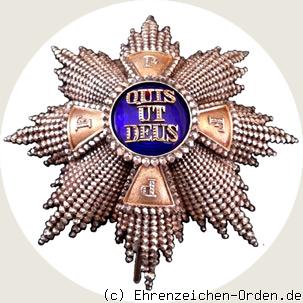 Obverse: Order of Merit from Mikhailovsky Breast Star to Grand Cross
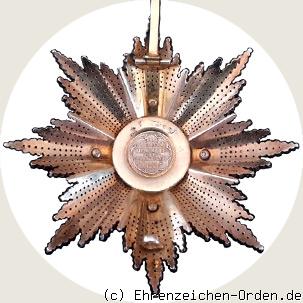 Reverse: Order of Merit from Mikhailovsky Breast Star to the Big Cross
Established:
February 16, 1837 by King Ludwig I.
Data:
- Material: silver, gold, enamel
- Size: 101mm
- Weight: about 121g
estimated collector price:
4700 - 4900 € Silver/Gold
2800 - 3000 € in silver/gold plated silver

 Awards of World War II