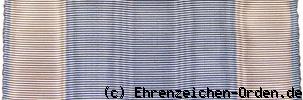
German Awards - Order of Merit of the Bavarian Crown (Civil Merit) Grand Cross
The Order of Merit for the Bavarian Crown was established by King Maximilian Joseph I on May 19, 1808. This order is also known as the Crown Order of the Bavarian Crown or the Civil Order of Merit. On the one hand, honored civil servants of Bavaria were awarded without taking into account rank and position, as well as foreigners who earned for the Bavarian crown. The award was associated with the elevation to the personal (not hereditary) nobility. When awarded the order for over 3 generations, the personal nobility was transformed into hereditary nobility. Cavaliers of the order were allowed to add the title to their name - Knights...
Initially, the order was established in 3 classes: the Grand Cross, Komtur and Knight. Gold and silver medals were awarded. Under King Maximilian II. a Grand Komtur class was added. The number of individual classes was limited. Initially, only 12 large crosses, 24 komturny and 100 knightly were allowed to be awarded. With the revision of the statutes in 1817, the number of awards was increased to 24, 40 and 160. Although the award was not tied to any specific status, the award took into account that the lent should also have been able to lead a decent life. Thus, the awarded person had to have sufficient financial resources, land ownership or other property, which excluded the awarding of "ordinary citizens." For military merits he was awarded the Order of Max Joseph, which entailed the same privileges (personal nobility). The breast star also belonged to the awarding of the Grand Cross and the Grand Commander. A large cross 90 mm and a large comture 75 mm.
Eight-arm golden cross of 4 long and 4 short cruciform arms. Enameled crosses are white. At the ends of the crosses there are 2 tips (similar to the Ioannite cross). Front and back sides with false, round, gold and enameled medallion. Between the cruciform shoulders is a pointed radial wreath. Along the outer edge of the cross sleeves, enveloping a light, golden oak-leaved wreath, the leaves are enameled with green. At the bottom it is tied with a golden loop, the ends of the tape swayed left and right. Cruciform brackets are superimposed on the wreath at the front and back. Between the tops of the upper cruciform shoulder is an agraff, to which a golden crown is attached. A ribbon ring passes through the imperial crown apple.
Front side:
- The round medallion is gold with a wide red enameled hoop.
- It has a gold inscription - VIRTUS - ET - HONOS - (Virtue and Honor)
- Below is a floral decoration in the form of 2 branches.
In - a surrounded field on a blue and white background in the shape of a rhombus,
- Laying the golden crown.
Downside:
- The round medallion is gold with a wide red enameled hoop.
- It has a gold inscription - MAX.- JOS.- BOJOARIAE - REX -.
- Below is a 5-leaf bloom.
- An enclosed golden field with rays in the background.
- It rises a portrait of Maximilian Joseph I facing to the right.
Tape:
Strap/ribbon of the large cross 100 mm, edges light blue 3 mm, white side stripes 18 mm, central stripes light blue 52 mm.
Photos taken with www.medalnet.net support
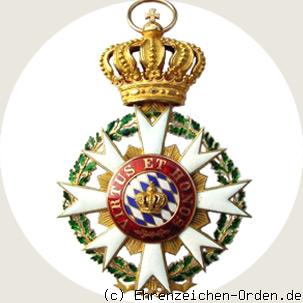 Obverse: Order of Merit of the Bavarian Crown (Civil Merit) Grand Cross
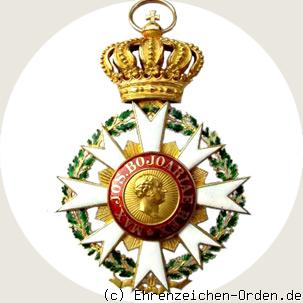 Reverse: Order of Merit of the Bavarian Crown (Civil Merit) Grand Cross
Established:
May 19, 1808 by King Maximilian Joseph I.
Data:
- Material: gold, enamel
- Size: 113mm x 73mm cross, 41mm x 39mm crown
- Weight: 69.2g
estimated collector price:
13000 - 14000 € in gold
7000 - 8000 € silver gilded

 Awards of World War II