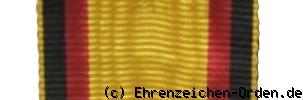
Awards of Germany - Medal "For Merit," Order of Merit of the 2nd degree, Medal "For Art and Science"
This medal was established on July 3, 1857 by Prince Georg Victor under the name "Medal of Merit." The medal was awarded for services to the princely house and country. Over time, with the same design, the medal underwent several changes. On January 14, 1871, Prince George Victor established the Order of Merit (also called the House Order). The Medal of Merit is now the 2nd Class Order of Merit. As such, the medal was awarded from 1871 to 1890. The following amendment took effect with the establishment of a new 2nd Class Order of Merit as a cross on 14 January 1891. The medal was now awarded as a gold medal of merit, which was a separate badge of honor. Previous medal winners as 2. The Order of Merit could be exchanged for a new cross. As a Gold Medal of Merit, the award existed from 1891 to 1899. After Prince Frederick came to power, the order system in the Waldeck principality was changed. On July 4, 1899, the Gold Medal of Merit became the Medal for Art and Science, and now for services in this area. After expansion by the Great Medal for Art and Science on June 28, 1903, the medal was called the Small Medal for Art and Science. The medal maker was J. Godet & Sohn of Berlin. Donated items were always made of gold. The parts that occur in silver can be purchased privately. For the entire rental period, 214 awards are indicated under 5 different designations. Due to high returns, replacement with a 2nd class cross, etc., fewer medals can be expected. Source: J. Nimmergut, Deutsche Orden und Ehrenzeichen bis 1945, vol. III, 1999.
Gold round insignia in two parts. The front side with the worn medallion is enameled. On top is an agraf of 2 golden leaves with an ear and a ribbon ring. The back is golden, smooth and arcuate.
Front side:
In the - center is an 8-beam, golden burgundy, black enameled coat of arms of Waldeck.
- Between the 8 main beams there are 5 intermediate beams graduated to the center.
- The central shield of the star with a golden border. The inner field is enameled with white.
- It is dominated by the golden burgundy and red translucent enameled anchor cross of Pyrmont.
- On the top beam of the star hangs a decorated gold monogram - GV - (Georg Viktor).
- Above the monogram is a reddish-white enameled princely hat reaching the leaf decanter.
- The round main body of the badge of honor with a wide blue enameled writing ring and a gold border.
- The gaps between the ring and the star are golden. On the ring is a golden letter:
- Below the center, separated by rays - Dem -/- Ver -/- dien -/- ste. -.
- Above the center on the right and left are 6 layers of a golden star.
Downside:
- Golden and domed dorsum, which also overlaps leaf agaffs.
Tape:
- golden yellow 36 mm wide, edging 1 mm, side stripes black/red 4 mm each.
.
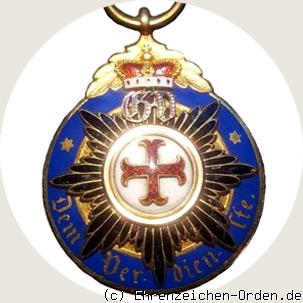 Obverse: Medal of Merit, Order of Merit, 2nd Class, Medal for Art and Science
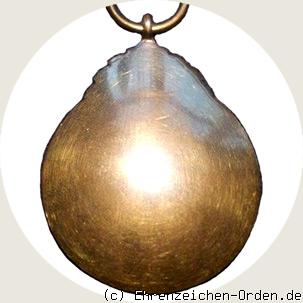 Reverse: Medal of Merit, Order of Merit, 2nd Class, Medal for Art and Science
Established:
On July 3, 1857, Prince George Victor was awarded the Medal of Merit
On July 4, 1899, Prince Frederick renamed Med. Art and science
Data:
- Material: gold, enamel
- Size: 30mm x 44mm
- Weight: approx. 16.5 - 18 g
estimated collector price:
2100 – 2500 €
OEK Number:
2844/1, 2846, 2870

 Awards of World War II