Awards of Germany - Order of the Red Eagle - breast star to the Great Cross with oak leaves
The Royal Order of the Red Eagle originated from the highest Brandenburg Order of the Red Eagle. On June 12, 1792, King Frederick William II confirmed. (Great) this order as a royal award. As changes, he introduced the Prussian royal crown, instead of the princely crown, and the letters F-W-R (Friedrich, Wilhelm, Rex, that is, the king) on the reverse. The slogan of the order is "Sincere et constanter" (Sincere and constant). During the existence of the award, many changes have been made. The order was founded in 1810 by King Frederick William III. expanded to 2nd and 3rd class. The breast star also belonged to the 1st class. The chest star for the 2nd grade was introduced in 1830. Oak leaves were first donated in 1811 to Knights 2nd Class, who had previously held 3rd Class. The same applies to 1. Class that was previously 2. and 3. Owned a class. In 1848, swords were established for military merit. In the period from 1848 to 1854, orders with a purple eagle and a raspberry eagle met in the medallion. In 1861, the 1st class of the order was awarded the Grand Cross with a chain and 1st. The class is divided. At the same time, the Elector-Brandenburg eagle with a scepter was again introduced into the order insignia. From that moment on, he decorates the medallion of the Grand Cross. 1st class retained in catches an eagle with a hohenzoll chest shield and a laurel wreath. Since 1854, the crimson color of the eagle in the medallion has been replaced by scarlet. Additional extensions of the order were a loop, a crown, jubilee numbers, and the upper classes had oak leaves, a crown and scepter, a bandeau to the order of the crown, a chest star and a large cross with a chain, as well as a Johannite cross. Source: J. Nimmergut, Deutsche Orden und Ehrenzeichen bis 1945, vol. II, 1997.
Eight-pointed silver gold-plated breast star. There are 5 intermediate beams between 8 main beams. The rays are bordered laterally by narrow lines. A round gold medallion is placed on the obverse. On the upper rays of the star lies 3-leaf, golden oak foliage. Back side with round lining and perpendicular pin.
Front side:
- Medallion with a 2 times larger border. Outside is a swirling pearl line inside.
- The wide ring of the font is enameled in blue with a gold inscription:
- - SINCERE - ET - CONSTANTER - 2 tied green laurel branches from below.
- Inside is another raised, stepped ring. Middle ring is twisted.
- In the included field on a white enameled background:
- Elector-Brandenburg red eagle with scepter (left) and sword (right).
- On the head is a red princely hat. The chest shield is light blue with a golden scepter.
Downside:
- Smooth and gilded, angled needle.
- A large round lining along the edge is corrugated.
.
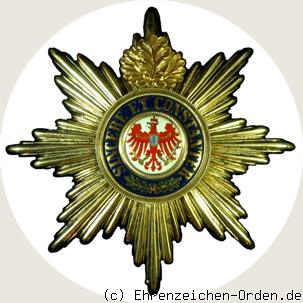 Obverse: Order of the Red Eagle - breast star to large cross with oak leaves
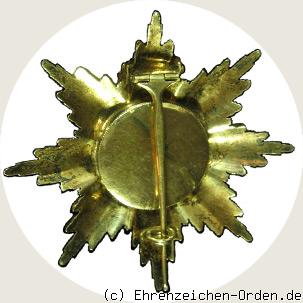 Reverse: Order of the Red Eagle - breast star to the Great Cross with oak leaves
Established:
June 12, 1792 by King Frederick William II.
October 18, 1861 unit of the Grand Cross and 1. That is sick
Data:
- Material: silver, gold, enamel
- Size: 91mm
- Weight: 80g
estimated collector price:
8500 - 8800 € silver/gold 5100 - 5500 € silver/silver with gilding

 Awards of World War II