Awards of Germany - Order of the Red Eagle - 2nd class breast star with oak leaves and swords 1864-1918
The Royal Order of the Red Eagle originated from the highest Brandenburg Order of the Red Eagle. On June 12, 1792, King Frederick William II confirmed. (Great) this order as a royal award. As changes, he introduced the Prussian royal crown, instead of the princely crown, and the letters F-W-R (Friedrich, Wilhelm, Rex, that is, the king) on the reverse. During the existence of the award, many changes have been made. In 1810, the order was established by King Frederick William III. expanded to the 2nd and 3rd grade. Oak foliage was donated on January 18, 1811. Oak Leaves was awarded to Knights 2nd Class who had previously held 3rd Class, as well as 1st Class if they had previously held 2nd and 3rd Class. The class was. The 2nd class of the order in 1830 was divided into 2. Class with and without breast star. In the period from 1848 to 1854, orders with a purple eagle and a raspberry eagle met in the medallion. Since 1854, the crimson color of the eagle in the medallion has been replaced by scarlet. On September 16, 1848, swords were granted for all classes.
The cross depicted was made by the Berlin manufacturer Wagner & Söhne. The award number for chest stars of the 2nd class with swords is indicated as 209. Source: J. Nimmergut, Deutsche Orden und Ehrenzeichen bis 1945, vol. II, 1997.
Four-beam star made of silver. The 4 main beams are the longest. Between them, another 9 rays are uniformly graduated in line. Between all rays, respectively, thinner, shortened intermediate rays. The white-enameled order cross of the Order of the Red Eagle is assigned to the body of the star. The cross is connected to the star by 4 ball head rivets. Crossed in the middle, between the cross sleeves, 2 golden swords with Roman paired poles. On the upper cruciform shoulder is a seated 3-leaf, golden oak foliage. Rear side with vertical gold-plated pin and central round cover. Came under a needle hook - W - for manufacturer Wagner & Söhne, Berlin.
Front side:
- The cross of the order is a golden board with white enameled cross sleeves and a round middle shield.
- Median shield with raised, twice ribbed edge. Outside is a wide white enameled ring.
- It has a painted gold font: - SINCERE - ET - CONSTANTER - (sincere and permanent)
- Below 2 tied below, green laurel branches of 5 leaves each.
- The temporal ring is bounded inward by a raised, corrugated, golden border.
In - the surrounded field, a red eagle with a crown is painted on a white enameled background.
- On the chest is a Hohenzoll chest shield, and in the paws is a green laurel wreath.
Downside:
- Smooth and silver with a vertical gold-plated pin with a soft end.
- Above and below, as well as on the side of the round cover plate 4 ball heads of rivets.
- Oak foliage is fixed with a small screw.
- Under the needle beam is the manufacturer's designation - W -.
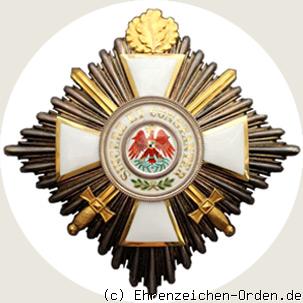 Obverse: Order of the Red Eagle - 2nd class breast star with oak leaves and swords 1864-1918
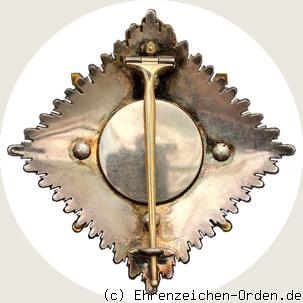 Reverse: Order of the Red Eagle - 2nd class breast star with oak leaves and swords 1864-1918
Established:
June 12, 1792 by King Frederick William II.
January 18, 1810 Foundation of the 2nd and 3rd class of King Frederick William III.
September 16, 1848 Fund of swords of King Frederick William IV.
Data:
- Material: silver, silver with gold coating, enamel
- Size: 79.5mm, swords 3 x 61mm, oak foliage 13 x 14mm
- Weight: about 71g
estimated collector price:
4500 - 4700 € Silver/Gold
3100 - 3300 € in silver/gold plated silver

 Awards of World War II