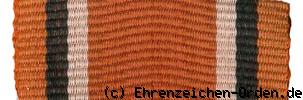
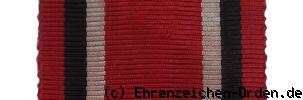
Awards of Germany - Medal of the Red Cross 2nd class of 1898
The Red Cross Medal was established on October 1, 1898 by King and Emperor William II. donated. The foundation was inspired by his wife, Queen Auguste Victoria, who, as the highest defender of the Red Cross societies, wanted to establish an award for the work of societies in peacetime. Until then, merit in the Red Cross during the war was judged by awards such as the Common Badge of Honour or the Order of the Crown with the Red Cross conferred. The Red Cross Medal is awarded in 3 classes. 1st class was a cross, 2nd and 3rd. He has medals in silver and bronze, respectively. The award was given to men, women and virgins who have earned it through years of Red Cross activity or outstanding action. The prerequisite for achieving higher class was lower class ownership. Provided for at least 5 years. The second class could be obtained immediately. In this case, 3rd grade was borrowed. 2 and 1. The class was subject to return upon death.
Shown here 2. The class existed in silver and in silver-plated copper. There are also differences in hatching under the glazed enameled Red Cross. On early silver products, the hatching was still manual, later, especially on silver-plated products, it was captured. Perpendicular hatches and hatches are known in the wall design. For silver-plated medals, 4 letters are slightly larger and thinner. On December 17, 1900, a decree was issued stating that rings could be awarded for merits in the war. There are 3 known inflections: - South Africa 1899-1900 -, - East Asia 1900/01 - and - South-West Africa 1904/06 -. Miniatures and half-sizes were also produced. Half dimensions have a diameter of about 24 mm.
The round, silver medal is partially enameled with a raised border. Above is a soldered ordinary eye with a ribbon ring.
Front side:
- Geneva cross with 4 Prussian royal crowns at the ends of the cross sleeves
- Geneva cross after a small border inside with red transparent enamel.
- Underneath is a translucent hatch.
In the - corners of the Geneva Cross letters:
- Upper left: - W -, upper right: - R -, lower left: - A -, lower right: - V -.
- (for Wilhelm - Rex - Auguste - Victoria)
Downside:
- On the left, an oak branch of foliage swayed in a semicircle.
In - four lines the inscription: - FOR -/- MERIT -/- FOR THIS -/- RED CROSS -.
Tape:
30 mm red (light red to dark red), edges 3 mm, black and white edge strips 2.5 mm each.
.
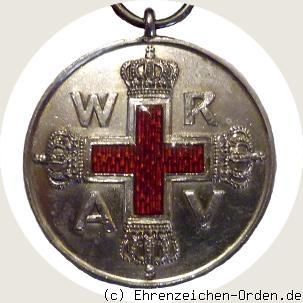 Obverse: Red Cross Medal 2nd Class 1898
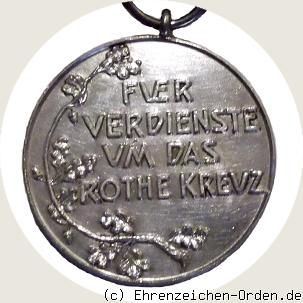 Reverse: 2nd Class Red Cross Medal 1898
Established:
October 1, 1898 by the emperor and king William II.
Data:
- Material: silver/partially enameled
- Size: 33.2mm
- Weight: 15.6g
estimated collector price:
70 – 90 €

 Awards of World War II