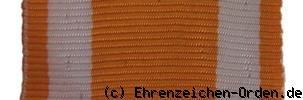
German Awards - 1833 Ribbon Escape Badge of Honor (4th Model)
The medal was established on February 1, 1833 by King Frederick William III. The Medal "For Salvation from Mortal Danger," established back in 1802, was established as the highest level in order to be able to show its merits externally. (The medal, donated in 1802, was not portable and was considerably larger.) These medals were awarded to persons who endangered themselves in order to save and help fellow citizens. For particularly excellent assistance, then a small portable medal was awarded. Medals were subject to return in the event of the death of the awarded. Starting in 1906, relatives of the victims could purchase the medal.
During the rental, 4 different models were minted. One difference is the spelling of King, with -O- on the last 3 models and once with -OE- on the 1st model. The upper end of the inscription was used as a star, on the 1st embossing, as a cross of 4 balls, on the 2nd embossing, or as an outlet of 6 balls, on the 3rd and 4th. Embossing by embossing. This is a sign of the age or period of the award. Shown here 4. Embossing or 4. The model was awarded from 1907 to 1918. Differences from the 3rd embossing are, in particular, the absence of a stamp break on the reverse side in an oak wreath, sharper embossing of the front side font and minor differences in the design of the letters. Model 4 was produced 2,800 times. Of these, 760 were melted down, a total of 2040 medals remained.
A small round silver medal with a rim, a soldered eye with a ribbon ring on top.
Front side:
- Along the edge is the inscription - FRIEDRICH - WILHELM - III - KÖNIG - VON - PREUSSEN -.
- Between the beginning and end of the font at the top there are 5 scanty sockets with a middle ball.
In - the locked midfield on the left is the head of Friedrich Wilhelm III.
Downside:
- Along the edge is a dense, turning oak-deciduous wreath with fruits.
In - closed midfield, 4-line font:
- - FOR -/- RESCUE -/- SHUTDOWN -/- DANGER -.
Tape:
Width 28 mm, orange with white side stripes of 4 mm.
.
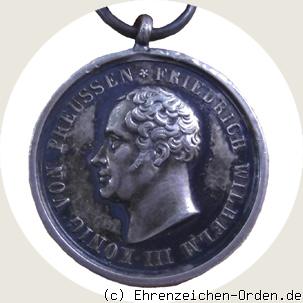 Obverse: Badge of Honor for Escape from Danger on the 1833 Ribbon (4th Model
)
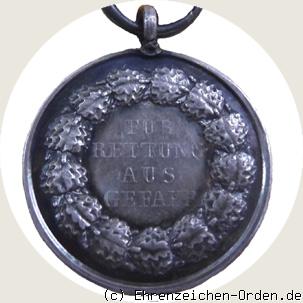 Reverse: Badge of Honor "For Saving from Danger" on the ribbon of 1833 (4th model)
Established:
February 1, 1833 by King Frederick William III.
Data:
- Material: Silver
- Size: 25mm
- Weight: about 7g
estimated collector price:
110 – 130 €

 Awards of World War II