German Awards - Oldenburg House and Order of Merit Officer's Cross 1903
This order was established on November 27, 1838 by Paul Friedrich Augustus and was supposed to remind of the 25-year return of his father. Initially, the order consisted of classes: Grand Cross, Grand Komtur, Komtur and Small Cross (from 1860 knightly crosses). Attached to the order is a common badge of honor in 3 classes: gold, silver and iron. The large crosses were divided into gold and silver crown crosses in 1841. In 1856, for merits in the war, this award was expanded with 2 swords passing through the center. With a higher talent in peacetime, they were added to the ring. To the Common Badge of Honor 1. The class was awarded a gold crown. In 1883, the General Badge of Honor was renamed the Cross of Honor. In 1903, the Officers' Cross was established between Komtur and Knight's Cross 1. The class stands. Knight's Crosses 2nd Class were split in 1906. Knight's Crosses 2. Class without crown. The last expansion was the Laurel Fund for sword crosses in 1918.
The officer's cross was awarded 330 times. As a manufacturer of crosses, only Bernhard Knauer (court jeweler) from Oldenburg is known. The name of the manufacturer shall be indicated under the needle. For military merits, the cross was awarded swords and swords on the ring. In 1918, single crosses with swords and laurels came to the award ceremony.
The silver cross is partially gilded with white enameled cross sleeves on the front. On the front side of the overlay is a round gilded medallion with a raised border. The back side is silver with a vertical pin.
Front side:
- Cross sleeves with wide gilded edges.
- The central sign with a red enameled round ring with the inscription:
- - ONE - GOD - ONE - RIGHT - ONE - TRUTH -
In - the center, with a gold, raised border, on a blue enameled background
- gold, intertwined letters - P - F - L -
- Nickname Peter Friedrich Ludwig, under the golden crown.
Downside:
- Smooth and silver with a vertical pin.
In - the center is a round smooth medallion.
- The manufacturer's designation is B. Knauer - under the needle.
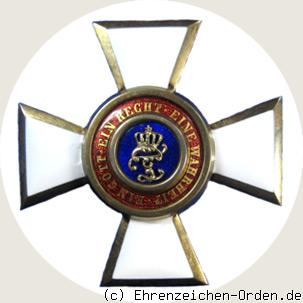 Front: Oldenburg House and Order of Merit Officer's Cross 1903
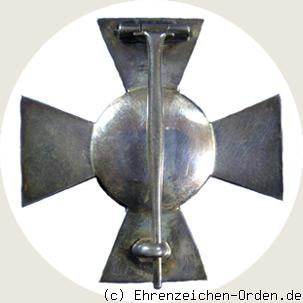 Reverse: Oldenburg House and Order of Merit Officer's Cross 1903
Established:
November 27, 1838 by the Grand Duke Paul Friedrich Augustus
1903 Officer's Cross
Data:
- Material: silver, gold plated, enamel
- Size: 45mm
- Weight: 17g
estimated collector price:
1000 – 1200 €

 Awards of World War II