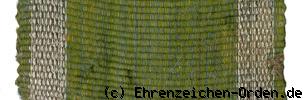
Awards of Germany - Officer Military Award 1853
The badge of honor presented here was awarded after the assumption of office of Duke Ernst I in 1853. The establishment decree is dated later. Service awards for officers are extremely rare. This is the last monogrammed form to be awarded - E -. Under a military convention with Prussia in 1867, officers were awarded the Prussian Cross. The provisions remained the same, but were expanded by rewarding non-combatants. With faithful and morally good leadership, officers in the contingent and gendarmerie could also be awarded after years of service. In the Duchy of Saxe-Altenburg, military service awards were first established on January 1, 1836 by Duke Joseph Friedrich Ernst. A cross was established for officers after 25 years of service and buckles for sergeant major, non-commissioned officers and soldiers in 3 classes. The 1st class for sergeant major below was a silver gilt buckle and was awarded for 12 years of service. The 2nd grade with the same design was a silver buckle and became 9th. Years of service. Shown here 3. The class consisted of black cast iron with a silver frame. Only active years of service were considered. Vacation was paid only half. Wartime was considered double. When Duke Georg Karl Friedrich took office in 1848, the cipher changed to - GKF -. It was replaced by the cross or buckle shown here. All service awards to officers are extremely rarely due to the short recruitment period and the number of contingent.
Silver cross with gold medallions. The crosses are slightly curved at the ends. The edges of the cruciform shoulders are bordered by gold edges, which are soldered. The inner sides of the cross sleeves are decorated with inward-facing scales. On the upper cruciform shoulder is a golden ear with a golden ribbon ring.
Front side:
- Golden central shield with raised smooth border.
- The closed midfield is rough and matte golden.
In - it rises the Gothic code - E - with a crown above it.
Downside:
- Golden central shield with raised smooth border.
- The closed midfield is rough and matte golden.
In - it, the Roman number 25 - XXV - increases.
Tape:
- Green 40mm with 6mm silver side strips and 1mm green edges.
.
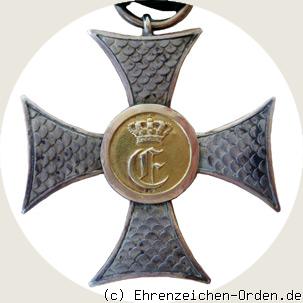 Obverse: Officer Military Decoration 1853
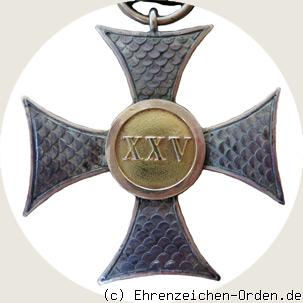 Reverse: Officer Military Decoration 1853
Established:
December 15, 1860 by Duke Ernst I.
Data:
- Material: silver, gold
- Size: 39mm
- Weight: about 11g
estimated collector price:
Unspecified

 Awards of World War II