German Awards - Medal "Labor for the Fatherland"
The medal "Labor for the Fatherland" was established on July 19, 1870 by Queen Augusta, with the consent of her husband, King William I. Merits were noted in caring for the wounded and sick in the war of 1870-1871 against France. Only women and virgins who received outstanding services in caring for the wounded during the war were awarded. I do not know anything about the criteria for assignment. Like the cross of merit for women and virgins, established later, it can be assumed that the proposals for awarding were made directly by the queen to her husband the king. The badge of honor is extremely rare and was awarded only 8 months. The award ended with the establishment of the Cross of Merit for Women and Virgins, which was awarded for the same merits after the end of the victorious war. Awarding should be significantly or extremely less, unlike this cross. The exact number of awards has not yet been established. The medal was worn on the women's loop.
An oval medal of partially gilded and enameled silver with an enlarged, stepped rim. This is in a gold frame with an eye and a ribbon ring. The partially enameled back cover is protected by a domed glass pane.
Front side:
- In the center of the gilded smooth base, the letter - A - rises under the royal crown.
- At a short distance from the edge, the inscription - WORK - FOR - THIS - FATHERLAND - increases.
Downside:
- Against a silver background rises a large red enameled Geneva cross.
Including - the year increases - 1870 -.
Tape:
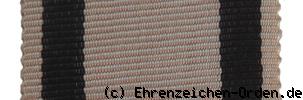
The female loop is white, edges 3 mm, with black side stripes 6 mm.
.
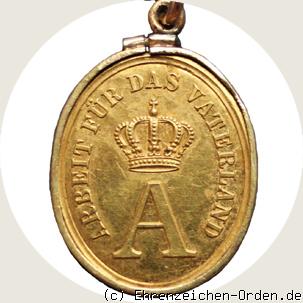 Front side: medal "Labor in the name of the Fatherland"
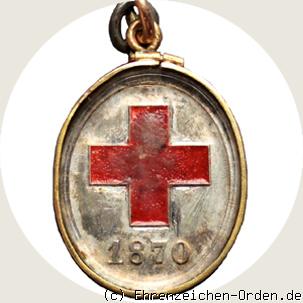 Reverse side: medal "Labor in the name of the Fatherland"
Established:
July 19, 1870 by Queen Augusta
Data:
- Material: gold, enamel, glass
- Size: 19.7mm x 23.7mm
- Weight: 3.5g
estimated collector price:
Unspecified

 Awards of World War II