Awards of Germany - Military commemorative coin for non-combatant 1814
Military commemorative coins were presented on January 7, 1815 by King Frederick William III after the liberation wars against Napoleon to persons who, during this time, while fulfilling their duty, shared the dangers or efforts of the soldiers, without directly taking part in hostilities and not being part of the army. For military personnel who, on the basis of orders, were denied participation in battles and, therefore, in awarding a commemorative coin for combatants, on March 6, 1817, a decision was made to expand the award statutes, justifying the awarding of a coin for non-combatants. According to him, officials who entered the battlefield, as well as military units that could not participate in hostilities for other orders and justified reasons, could also be awarded. These commemorative coins were awarded with the corresponding dates of the year. The following dates of the year are known on coins: 1813, 1814, 1813-1814 and 1815.
Commemorative coin 1813-1814 received all military units without distinction, whether they were used in fortresses or outside the country. Military commemorative coins for non-combatant were made at the Royal Iron Foundry in Berlin and at the Royal Iron Foundry in Gleiwitz. Most of the coins were made in Gleiwitz. They can be recognized by the spilled eye. Often, one is also found in the auricle - G. Commemorative military coins with an angel-shaped eye are considered a work from Berlin. Production figures (for all annual periods) are given in 9000 pieces for Berlin and about 88,000 for Gleiwitz.
An oval medal of cast iron with a raised border. A transverse large round eye is knocked out from above. On the ear is a recessed letter - G -.
Front side:
- Middle pointed cross with a round middle shield with a border.
In - the corners of the traverse.
In the - round central shield year - 1814 -.
Downside:
- On a wide, divided by a raised line bordered by the old census:
- - God - was - with - us. - To him - this - that - honor -! -
In - the closed field at the top, the crowned letters are F W -
- Among them is the 3-line old font: - For loyalty to duty -/- to them -/- to wars -.
Tape:
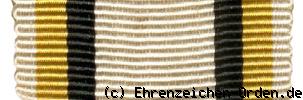
- 36 mm wide, white edges, side stripes yellow/black 4 mm each, central stripes 17 mm white.
.
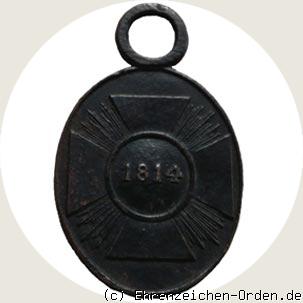 Obverse: 1814 non-combatant military commemorative coin
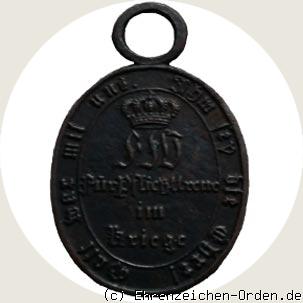 Reverse: 1814 non-combatant military commemorative coin
Established:
January 7, 1815 by King Frederick William III.
Data:
- Material: iron blackened
- Size: 30mm x 24.5mm
- Weight: 6.3g
estimated collector price:
150 – 170 €

 Awards of World War II