German Awards - Cross for Art and Science
The Arts and Sciences Merit Cross was established in 1906 after Duke Charles Edward took office. On February 02, 1907, the stages were refined and reorganized. The six levels for art and science were: 1. Cross of Honor, cross with fork with stone crown, 2. Cross with stone crown, 3. The cross represented here, 4. Gold medal with crown, 5. Gold medal and, as the lowest level 6. Silver medal. The Meritorious Service Medal designation was changed to the Arts and Sciences Medal. The cross depicted here, like the cross with the crown, was to be awarded only in special cases to outstanding figures engaged in self-creating activities in the field of art. The stamps were made by Max Kavachinsky (1860-1910). The crosses were made by L. R. Lauer at the Institute of Art Coinage in Nuremberg. Since about 1914, the court jeweler K. F. Zimmerman from Pforzheim and Bury and Leonhardt from Hanau supplied honorary crosses and medals. The first two tiers of stone-crowned crosses are extremely rare. Exact award figures are not known. However, less than 20 should be considered, as lower rungs such as the laurel wreath medal have only been awarded 21 times. Source: J. Nimmergut, Deutsche Orden und Ehrenzeichen bis 1945, vol. III, 1999.
An eight-pointed cross of Maltese shape made of gilded silver. Front and back with round, soldered middle shields. Cruciform brackets with a narrow raised edge are granular. Between the cruciform shoulders at a distance from each other is a rotating green enameled wreath with 3 rhombuses between the shoulders. Between the tips of the upper cruciform shoulder, the usual eye with a ribbon ring is soldered.
Front side:
- Round central shield without raised edge. In the center is a portrait of the duke, facing right.
- The shoulder cut with the cloak reaches the bottom edge and separates the font.
- Along the edge is the inscription - CARL - ° - EDWARD - ° - HERZOG - ° - V - ° - SACHSEN - ° - COBURG - ° - U - ° - GOTHA -.
Downside:
- Round central shield without raised edge.
A - short distance from the edge is a dense oak-deciduous wreath.
- This one at the bottom is tied in a double loop.
- In the nested field, the three-line font is FOR -/- ART - AND -/- SCIENCE -.
Tape:
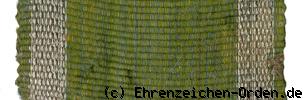
green 28 mm wide, edges 1.5 mm, silver side stripes 4 mm.
.
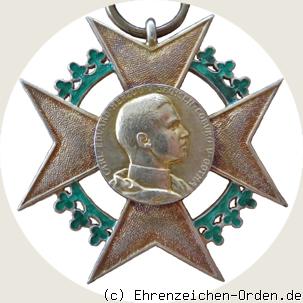 Obverse: Cross for Art and Science
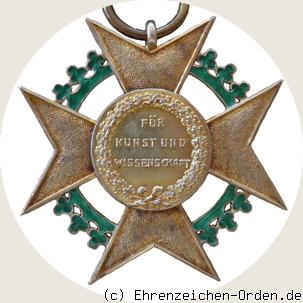 Reverse: Cross for Art and Science
Established:
1906 Duke Carl Edward
Data:
- Material: silver gilded, partially enamelled
- Size: 33mm
- Weight: about 12g
estimated collector price:
850 – 900 €

 Awards of World War II