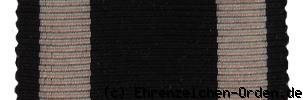
Awards of Germany - Royal Household Order of Hohenzollern Cross of Knights with Swords
This order was established by King Frederick William IV on January 18, 1851 on the occasion of the 150th anniversary of the coronation of Frederick I as the first Prussian king.
Thus, the princely order of the House that existed since 1841 was adopted by Hohenzollern as a royal order. However, it was found that the Hohenzollern house order falls into 2 orders. Royal and princely orders that existed and could be granted separately and independently of each other. The motto of the Royal House of Hohenzollern is "From Rock to Sea." The order was divided into 2 detachments of crosses and eagles. Crosses were determined by the motive of loyalty to the king. The fight against internal and external enemies should be expressed unambiguously. Crosses were divided into grosscomtur, komtur, knights and cavaliers. The Eagles also split into these classes. The 4th class of holders was only added in 1861 for both departments. Other expansions this year have been a star for big and Comtours. In the war of 1864, swords (for the separation of crosses) were donated for services to the enemy. In 1867 he was awarded the Order with the John Cross. The squad of eagles went mainly to scientists and civilians. Knightly crosses with swords could only be awarded to officers. Non-commissioned officers received the cross of the cavaliers. Military personnel who already had the Iron Cross of the 1st class were awarded. Crosses of knights with swords were also to be a protection for the award of the Order of Pour le Merite. The value of the order should not be diminished by frequent awards. In the practice of World War I, the cross was considered the predecessor of Pour le Merite, although there was no order in this regard. Crosses were made of gilded silver from about 1916. In total, about 7,000 sets of awards were played, which subsequently spread to the teams .
Gilded cross with rounded cross ends. The cross-shaped shoulders are enameled white with a black rim located at a distance from each other. A round medallion is placed in the center in front and behind. Between the cross sleeves with a gap is a green enameled wreath, to the left of laurel to the right of oak foliage. On this one, on the front side, 2 gilded swords are superimposed passing through the center. On the upper cruciform shoulder, a gilded Prussian royal crown is movably attached, on the reverse side of which a wide cruciform tape eye is installed.
Front side:
- Gilded medallion with a wide blue enameled rim. On it is a golden letter:
- - FROM - ROCK - TO - SEA - from below 2 tied green enameled laurel branches
In - a surrounded field, on a white background, a black enameled Prussian eagle with a Hohenzoller chest shield
- Crown, scepter and, imperial apple.
Downside:
- Gilded medallion with a wide blue enameled rim. On it is a golden letter:
- - DEN - 18 - JANUARY - 1851 - bottom 2 tied green enameled laurel branches
In - a surrounded field on a white background, golden winding letters - F - R - W -
- Above it is a golden crown.
Tape:
black ribbon 30 mm wide, edges 2 mm, white side strips 5 mm
.
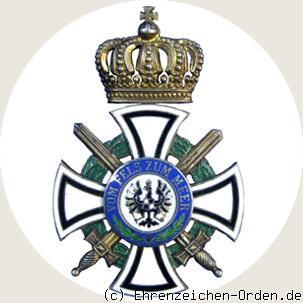 Obverse: Hohenzollern Royal Household Order Cross of Knights with Swords
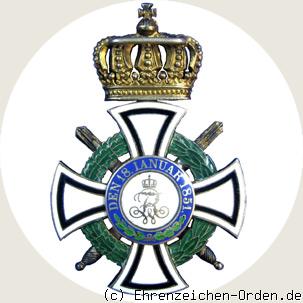 Reverse: Hohenzollern Royal Household Order Cross of Knights with Swords
Established:
January 18, 1851 by King Frederick William IV.
On February 27, 1864, the King William I Sword Foundation.
Awarded:
1851 – 1918
(since 1864 with swords)
Data:
- Material: silver gilded/enameled
- Size: 55mm x 37mm
- Weight: 24.5g
estimated collector price:
2700 - 2900 € in gold
770 - 810 € silver-gilded

 Awards of World War II