German Awards - Ducal Saxe-Ernestine House Order of Komturkreuz
The divisional cross was awarded from 1864 without a letter on the upper cross sleeve until 1935. Komtur 1. The class additionally received a breast star. The commander's cross was worn as a neck. Since 1864, the distinction between foreigners and foreigners has also disappeared. When awarded in peacetime, the green wreath was made of oak leaves. For military merit, the wreath was of bay leaves. Crosses were made of gold until 1917. Then from gilded silver. In 1919, Duke Karl Edward of Saxe-Coburg and Gotha resumed awards. The decision of the order - Fideliter et Constanter - can be written using ET or &. The Order of the Ernestine Duchies was established on March 25, 1833 jointly by 3 Dukes Ernst I of Saxe-Coburg-Gotha, Friedrich of Saxe-Altenburg and Bernhard Erich Freund of Saxe-Meiningen. Initially, the order consisted of 4 classes: Grand Cross, Komtur 1st class, Komtur 2nd class and Knight. Knights 2nd class were added around 1890. Foreigners could also be awarded the order. This required the consent of at least 2 duchies. The awards of the other classes were equally distributed among the 3 duchies. Until 1864, crosses were indicated by letters on the upper cross sleeve. F for Altenburg, E for Gotha and B for Meiningen. Foreigners received crosses without an oak wreath around the medallion. The Komtursky Cross was awarded from 1890 to 1913 575 times. Between 1919 and 1935, 139 gilt silver crosses were made for Saxony Coburg and Gotha. Source: J. Nimmergut, Deutsche Orden und Ehrenzeichen bis 1945, vol. III, 1999.
Maltese-shaped golden cross with small balls on 8 peaks. Enameled crosses are white. Support and reverse with superimposed round gold medallion. Between the cross hands, the lion shouts up or down, respectively. Between the tops of the upper cruciform arm 2, the broad bridges are movably connected to the semi-serpentine ducal crown attached from above. An elongated ribbon ring passes through the imperial apple of the crown.
Front side:
- The golden central shield is surrounded by a green enameled oak-leafy wreath.
- Above and below they are connected crosswise.
- Then a golden burgundy blue enameled ring with a gold inscription:
- - FIDELITER - ET - CONSTANTER - Below is a small 6-ray star.
In - a surrounded, finely delineated golden field, a portrait of the duke, looking to the left
- Ernst the Pious (founder of the Gothic branch of the Reg. 1640-1674)
Downside:
- The golden central shield is surrounded by a green enameled oak-leafy wreath.
- Above and below they are connected crosswise.
- Subsequently, a blue enameled ring with a gold inscription: - D. - 25. - DECEMBER - 1833
- - At the bottom is a 6-ray star, on the left and right are a dot.
In - a surrounded field, the coat of arms is Saxon, with a green enameled diagonal diamond crown.
- Horizontal stripes are black enameled or gold with a border, dotted inside.
Tape:
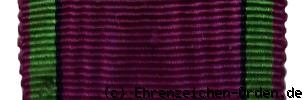
- purple 58 mm wide, edges 2 mm, green side stripes 6 mm, black dividing line.
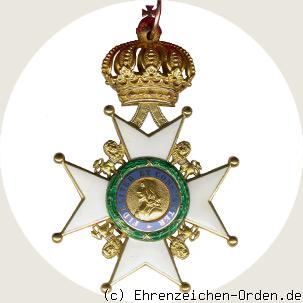 Obverse: Ducal Saxe-Ernestine House Order of Komturkreuz
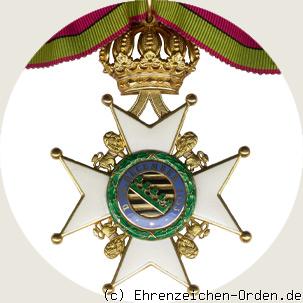 Reverse: Ducal Saxe-Ernestine House Order of Komturkreuz
Established:
March 25, 1833 together with Dukes Ernst I, Friedrich and Bernhard Erich Freund
Data:
- Material: gold, enamel
- Size: 84.5mm x 56mm, crown 29mm x 28mm
- Weight: 34g
estimated collector price:
1900 - 2000 € gold 1200 - 1400 € silver

 Awards of World War II