German Awards - Ducal Saxe-Ernestine House Order Breast Star to Grand Cross
The ducal Saxe-Ernestine House Order was established on March 25, 1833 jointly by 3 dukes Ernst I of Saxe-Coburg-Gotha, Friedrich of Saxe-Altenburg and Bernhard Erich Freund of Saxe-Meiningen. Initially, the order had 4 classes: Grand Cross, Komtur 1st class, Komtur 2nd class and Knight. The motto of the order was "Fideliter et constanter" Faithful and steadfast. The Grand Cross of the Order, as the highest class, was awarded to foreigners and foreigners. The princes of the 3 duchies were born with large crosses and entered the order at the age of 18. The principalities of friendly countries also received large crosses. Non-notables could also be awarded if they held at least the office of actual Privy Counsellor or a comparable position. The number of large crosses for inner ones was limited to 3 for each duchy, with the exception of the ruling house. There were no restrictions for foreigners. However, the award required the consent of at least 2 duchies. Until 1864, crosses were indicated by letters on the upper cross sleeve. F for Altenburg, E for Gotha and B for Meiningen. Foreigners received crosses without an oak wreath or a laurel wreath around the medallion.
The pectoral stars of large crosses vary greatly in size and weight. The body of the star can be made smooth and shiny. There are differences in the design of the cross. (Here with a wide edge) The central part can be finely grainy or, as here, with a ray wreath in the background. An oak wreath can also be fastened 6 times crosswise. (Not here) Chest stars with crossed swords were awarded for military merit through the centre. Other extensions included chest stars with diamonds and a folding medallion and swords on the ring in 1935. Early manufacturers of breast stars were Bury & Leonhard of Hanau and probably Fa. Fischer & Consorten. Another notable manufacturer was J.Godet & Sohn of Berlin. The Order of the House continued to be awarded from 1919 to 1935 by Duke Charles Edward of Saxony of Coburg-Gotha. A total of 270 crosses were awarded. Source: J. Nimmergut, Deutsche Orden und Ehrenzeichen bis 1945, vol. III, 1999.
Eight-pointed pectoral star. The stellar body consists of 8 beams of radiation. Vertical and horizontal radiation beams are gilded, diagonal - silver. Laying and riveting a gold, enameled order cross. The reverse is smooth, silver with a perpendicular pin with an opposite hook. In the center is a round overlay with the manufacturer's designation on it. Here on the side there are 2 additional support hooks.
Front side:
- The order cross consists of 4 white enameled cross hands and a large round medallion.
- Cruciform arms with wide gold decorated edges. Inside and outside rolled, deepened in the center.
- The ends of the spider are beveled to the center. On the tips are small gold balls.
- Medallion with a wide, green enameled and golden burgundy, circulating oak-leafy wreath.
- Then - a blue enameled ring. The cover of the golden motto of the order in capital letters:
- - FIDELITER - ET - CONSTANTER - Letters in horizontal decorative section, 4-petal flower below.
- The included midfield is golden with a raised, rolled edge.
A - green enameled diamond crown is laid on the central radial crown.
Downside:
- Smooth and silver. On the round lining of manufacturers - GODET -/- IN -/- BERLIN -.
- Vertically - a pin with a reciprocal hook. Side 2 additional support hooks.
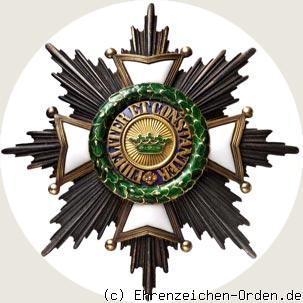 Front: Ducal Saxe-Ernestine Household Order Breast Star to Grand Cross
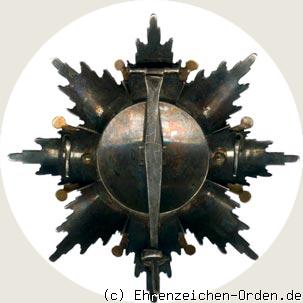 Reverse: Ducal Saxe-Ernestine Household Order Breast Star to Grand Cross
Established:
March 25, 1833 together with Dukes Ernst I, Friedrich and Bernhard Erich Freund
Awarded:
1833 – 1918 – 1935
Data:
- Material: silver, gold, enamel
- Size: 81 to 93mm
- Weight: 51 to 100g
estimated collector price:
2600 – 2800 €

 Awards of World War II