German Awards - Duke Ernst Medal in Gold
Duke Ernst II. Established this medal on February 17, 1888. A statute of 21 February 1889 established that a medal could be awarded on a collar. As a special award, the medal was also awarded gilded in silver. Nimmergut specifies only 4 1st form awards with stamp incisor. Also in the baseboard there is a mold without a punch-cutter. Here, Gessenthal and Schreiber, as well as Nemmergut, have 6 awards. There are different pendants. With a small stem and eye or, like the medal shown here, with an eye, ring and elongated double ribbon ring. The true purpose of the award was to reward services that should not have been awarded the Order of the Ducal Ernest House or the Medal for Art. In contrast, artists who already had other Coburg-Gotha awards were awarded. Medals were minted by L. R. Lauer in Nuremberg. The stamps were made by H. Strobel, a coin engraver in Nuremberg. With permission, 34 mm gearboxes were also made, designed to be worn on order buckles. Medals are very rare in all sizes. Source: J. Nimmergut, Deutsche Orden und Ehrenzeichen bis 1945, vol. III, 1999.
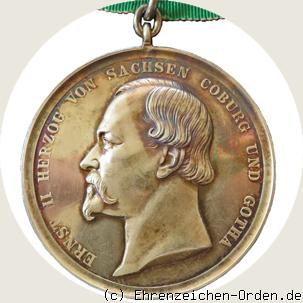
Round medal of gilded silver with a raised border. On top is a soldered eye with a ring. A double elongated band ring is suspended inside it. On the left along the edge are a punch crescent, crown and 0.990.
Front side:
- On the margins is the inscription: - ERNST - II - HERZOG - VON - SACHSEN - COBURG - AND - GOTHA -.
In the - center is a portrait of the duke with a mustache and chin, looking to the left.
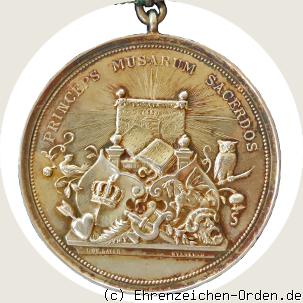
Downside:
- Inside, there is a circular pearl cord along the raised edge.
In - the upper half along the edge there is an inscription - PRINCEPS - MUSARUM - SACERDOS -
- (Prince is a priest of muses, or Prince is a saint's muses)
- In the center on the pedestal is a throne chair with bullets on the back and armrests. In the background is a ray wreath.
- On a florally decorated back in the middle is a Saxon coat of arms.
- On the seat at right angles lies a book.
- On the left is an in-depth - ZAIRE -/- SANTA -/- CHIARA -.
- On the right is an in-depth - DIANA -/- FROM -/- UNTIL THEN -/- CASILDA -.
- (Names of operas composed by the Duke)
- In front of the throne chair 2, curved shields of the coat of arms are inclined to the center.
- On the right shield rises a crown as a sign of princely dignity.
- On the left stands a winged horse, Pegasus, as a symbol of poetry.
- Various symbols are placed on a pedestal in front of the shields.
In the - center is a sloping lyre with a pierced sword. On the left is a palm leaf, and on the right is a bay leaf.
- On the left edge is an arrow-pierced heart for love, and on the right edge is a mask or Janus's head for tragedy. To the left of the 1st shield protrudes a rose branch, on which a dove or nightingale sits as a sign of singing. To the right of the second shield protrudes a branch on which an owl sits as a sign of wisdom.
- On the bottom paragraph of the pedestal, the names from the manufacturer and the stamp cutter are carved on the left - L.- CHR.- LAUER - central - NÜRNBERG - and on the right - H.- STROBEL -.
Tape:
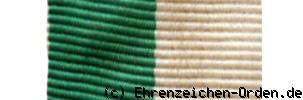
- Collar 35 mm each half green, white.
 Front: Duke Ernst Medal in Gold
 Reverse: Duke Ernst Medal in Gold
Established:
February 17, 1888 by Duke Ernst II.
February 21, 1889 Neck Decoration
Data:
- Material: Silver gilded
- Size: 50.2mm
- Weight: 49.8g
estimated collector price:
Unspecified

 Awards of World War II