Germany Awards - House Order of the Golden Lion breast star to Grand Cross
The breastplates to the grand cross of the Order of the Golden Lion were also made of metal from about 1850. Owners of embroidered stars could also privately make chest stars from metal. Most thoracic stars have shiny rays. The star featured here has smooth rays and is manufactured by Godet, Berlin. Another notable manufacturer is J. Bury of Hanau, which has made shiny breast stars.
The Order of the Golden Lion was established on August 14, 1770 by Landgrave Frederick II. Hesse-Kassel in one class. He celebrated his 50th birthday by celebrating civilian and military merit. The motto of the order is Virtute et Fidelitate - for virtue and loyalty. The order was not tied exclusively to any rank or class. The denomination also did not play a defining role. Particular attention should be paid to special merits, distinctive qualities, loyalty to the ruling house. The military had to be at least lieutenant general and had previously been awarded the military order "Pour la Vertu militaire." Civilians were to belong to the 1st class of civil ranks. The Grand Master was the corresponding ruler of the country, and the princes were born knights (from adulthood). The number of knights was not limited. The order obliged each knight to special loyalty to the prince. The main values of the order were considered virtue, loyalty, secrecy and charity. The badge of the order, worn on the sash, and the embroidered silver breast star depicted here were awarded. In the event of the death of a knight, the signs of the order were subject to return within 3 months. In 1818, Elector Wilhelm I expanded the order to 4 classes. The classes were now the Grand Cross, Commander 1st and 2nd. Class as well as Knights. Classes were now separated by position or rank. There was a principle of higher service. In 1821, the Order Chancellor was replaced by the Order Commission.
With the founding of the Order of William by Elector Frederick William I in 1851, who transferred 3 lower classes to this order, the Order of the House of the Golden Lion again became one-class. After the annexation by Prussia, the order was included in the number of Prussian orders and was subsequently lent by the elector. In 1875, after the death of Frederick William I, he was then excluded from the list of Prussian orders. Source: Jörg Nemmergut "German Orders and Insignia until 1945" Volume 1, 1999.
An achy, slightly curved pectoral star made of silver. Between the 8 main beams there are 5 intermediate beams graduated to the center. Individual rays are bordered laterally by narrow lines. In the center is a large round gold medallion. The reverse is smooth silver. In the center is a round overlay with the manufacturer's signature. Vertically - a pin with a reciprocal hook. On the side, left and right, one curved additional hook.
Front side:
- Medallion with raised, arched, gold, corrugated border.
- Then - broad writing. This one inside is limited to such a golden ring.
- The ring is transparent, enameled with red with a translucent bandage.
- Put the silver motto - VIRTUTE - ET - FIDELITATE - (For virtue and loyalty).
- Letters with thin cross hatching. At the bottom there is one point with 3 leaves on the sides.
- The closed midfield is transulent blue enameled with a dressing underneath.
- Suspended is a golden burgundy, left-stepping Hessian lion with a crown.
- The lion with raised ears is enameled alternately with white and red stripes.
Downside:
- The reverse is smooth silver with a perpendicular pin with a response hook.
In the - center is a large round smooth overlay, which is attached to the side with 2 rivets.
In the - center is a recessed rectangle with an enlarged 3-line signature of the manufacturer:
- - GODET -/- IN -/- BERLIN -. Side on horizontal beams 2 curved additional hooks.
.
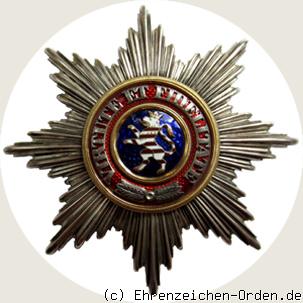 Obverse: House of the Order of the Golden Lion breast star to the Grand Cross
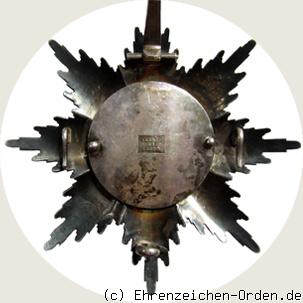 Reverse: Home Order of the Golden Lion breast star to Grand Cross
Established:
August 14, 1770 by Landgrave Frederick II.
Awarded:
1770-1875 (metal since 1850)
Data:
- Material: silver, gold, enamel
- Size: 81.5mm
- Weight: approx. 41.5g
estimated collector price:
2600 – 2800 €

 Awards of World War II