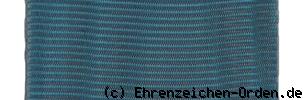
Awards of Germany - Insignia of sergeants and soldiers for 22 years
Honorary badges for officers, non-commissioned officers and soldiers were established on February 25, 1834 by the Duke Wilhelm. Before the foundation, seniority, as, for example, in Bavaria, was determined by chevrons. They were introduced on October 15, 1807. The purpose of the award was to reward faithful service and impeccable behavior in the army and to give an external sign in the spirit of the times. The fund was stimulated by regimental leaders of the Nassau infantry. The general command supported this and pushed the duke to the foundation. Together with the badge of honor for officers after 25 years, service signs for non-commissioned officers and soldiers were also established. These crosses had the same shape and decoration as the officers, but were made entirely of silver. Insignia in 3 stages were established for non-commissioned officers and soldiers. The 1st stage was granted after 10 years of service and had a size of only 25 mm. Level 2 required 16 years of service, and Level 3 was assigned after 22 years of faithful service. Second and third. The steps were 27 mm in size, as was the officer's cross. The corresponding Roman numeral for seniority is on the upper cross sleeve. Crosses made of silver-plated or gilded bronze are considered non-statutory or modern. Miniatures of 16 mm are also known, also made of silver. Source: J. Nimmergut, Deutsche Orden und Ehrenzeichen bis 1945, vol. II, 1997.
Eight-pointed cross made of silver. The ends of the crosses are only slightly beveled towards the center. Front and rear with a round central shield. Between the tips of the upper cruciform shoulder, the usual eye with a ribbon ring is soldered.
Front side:
- Round central shield with raised smooth edge.
In the surrounded - field is a large Gothic letter - W - for Wilhelm.
- On smooth polished cross-shaped hands embossed embossed font: from above - XXII - (25),
- Right - TRUE -, lower (head) - SERVICE -, left - IAHRE -.
Downside:
- Round central shield with raised edge.
- In the nested field, 3-line enlarged font: - 25. -/- FEBRUARY -/- 1834 -.
- Crosses are smooth without font.
Tape:
.
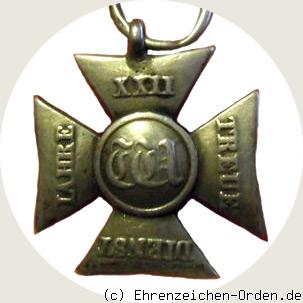 Front side: insignia of non-commissioned officers and soldiers for 22 years
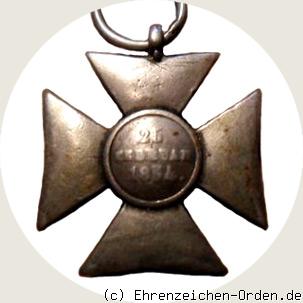 Insignia of sergeants and privates for 22 years
Established:
February 25, 1834 Duke William
Data:
- Material: Silver
- Size: 27mm
- Weight: 13.5g
estimated collector price:
300 – 330 €

 Awards of World War II