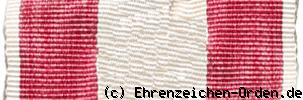
Awards of Germany - Commander's Cross of the Order of Concordia
The Order of Concordia was established on August 15, 1813 by the Prince Primate and Grand Duke of Frankfurt, Karl Theodor von Dahlberg (1744-1817). He chose Napoleon's birthday as the date of foundation. The order consisted of 3 classes, a large cross, a commander and a knight. Concordia's slogan or slogan was consent. Individual classes were limited to 12 large crosses, 24 commanders, and 24 knights. However, the Grand Duke reserved the right to expand. The order was awarded for excellent services of any kind. It was awarded, as a rule, only to the natives. A feature was the principle of exclusivity. That is, the lent was not allowed to have or accept other orders. The first award took place in February 1813 in Fontainebleau on the occasion of the completed church concordat. The charter was adopted only with an official fund in August. The Grand Master of the Order was the Grand Duke, and the Chancellor was Ober-Hofmeister von Pfirdt. Personal knightly nobility was associated with the oath, if the Belgian did not have a hereditary noble title.
Already in 1812, the Grand Duke von Dalberg announced the creation of the order to his Minister of State Secretary Baron von Eberstein. The decorations of the order were also made in 1812 by a court jeweler in Frankfurt. The award was to take place only after the end of the war. Until then, the orders were kept by the secretary of the order, the Privy Council and the secretary of the Müller cabinet. The list was compiled on July 11, 1814. After the Battle of Hanau on October 30, 1813, the victorious states of Austria, Prussia and Russia occupied Frankfurt on November 2, 1813. Grand Duke Karl Theodor Dalberg, who was under the protectorate of Napoleon, was forced to cede the Grand Duchy. It also ended the awarding of the Order of Concordia. The commander's cross shown here was worn as a neckpiece and awarded a total of 20 times.
The 8-ray star consists of 48 individual rays. Diagonal rays, 3 single rays, are elongated. The middle beam is longer and more powerful. The main horizontal and vertical beams are somewhat more powerful. Intermediate rays, each 4, are uniformly graduated to diagonal rays. Front and rear large round middle medallion. An ironing eye with balls at the ends is soldered to the upper beam. This has a somewhat fluted, elongated band ring.
Front side:
- Medallion with a raised, beveled outward smooth edge.
In - a closed field on edge 2 below, palm branches are tied, projecting upwards to about 4/5.
- Above is a curved solution of the order - CONCORDIA -.
- Between the palm branches and the writing is a circle of clouds open from below 4/5.
- In the background, sun rays emerge from the clouds.
- The arms protruding in the center left and right are combined into a handshake (left in the foreground).
Downside:
- Medallion with a raised, beveled outward smooth edge.
In - a closed field on the left and right, the bandaged ermine mantle in the center is elevated with a 5-arched crown.
- It has a rectangular shield with a chariot, the coat of arms of the Grand Duchy of Frankfurt.
Tape:
61 mm white, edges 3 mm, side stripes red 15 mm.
Photos courtesy of Arnold Auction House, Frankfurt/Main.
Images show an electroforming replica/cue.
.
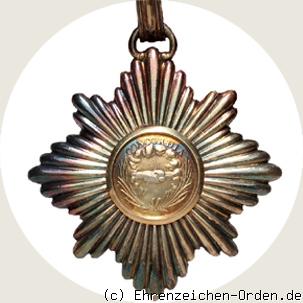 Obverse: Commander's Cross of the Order of Concordia
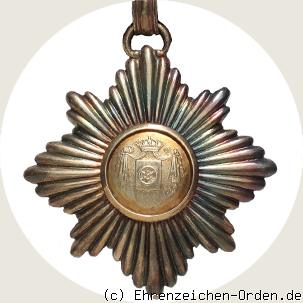 Reverse: Order of Concordia Commander's Cross
Established:
On August 15, 1813, Prince Primate and Grand Duke Karl Theodor Dalberg
Data:
- Material: Gold
- Size: 63mm
- Weight:
estimated collector price:
Unspecified

 Awards of World War II