German Awards - Bronze Medal for Life Saving 6. 1905 model intolerable
The bronze medal for saving a life, presented here, is presented as wearable and, like this one, as an unbearable award. Whether the medal was subsequently changed from borrowed to wearable, or whether both options were awarded in this way, is unknown to me. The founding of the lifesaving medals dates back to 1831. On May 18, 1831, King Anton, together with his co-ruler Friedrich August of Saxony, first established rescue medals in the German state. Prior to that, bonuses were paid for rescue statuses, which, according to the fund, were provided only in the form of exceptions. Medals were awarded in 3 stages, gold, silver and bronze were awarded wearable, as well as non-wearable. To receive the medal, it was necessary to look for the appropriate government district and justify the requested level. Medals were awarded in 6 versions, on the front of each of which was an image of the ruling king. The 1st form was granted in 1831-1836 and carried portraits of both founders. The 2nd form of 1836-1854 carried a portrait of King Frederick Augustus II, the 3rd form of 1854-1873 - a portrait of King Johann, the 4th form of 1873-1902 - a portrait of King Albert, the 5th form of 1902-1904 - a portrait of King George. Shown here 6. The 1904 uniform was issued until 1918 as the last uniform. The tagger was Max Bardulek. The number of awards with a bronze medal is 313 pieces. Circulation is estimated at 390. There are bronze and bronze copper medals.
Round bronze medal with raised border.
Front side:
- On the edge of the inscription: - FRIEDRICH - AUGUST - KING - BACKGROUND - SAXONY -
In the - center is a portrait of the king, facing right.
Downside:
- Along the edge at a distance is a dense oak-deciduous wreath.
- Above and below they are connected crosswise.
- In the included field, three-line font:
- - FOR -/- LIFE = -/- SALVATION -.
.
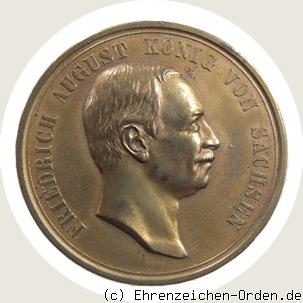 Face: Bronze medal for saving life 6. 1905 model intolerable
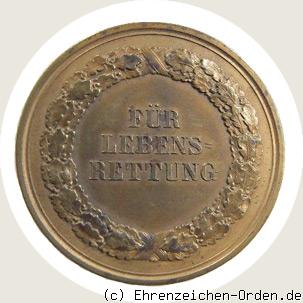 Reverse: Lifesaving Bronze Medal 6. 1905 model intolerable
Established:
May 18, 1831 by King Anton and co-ruler Frederick Augustus
1905 with the image of Frederick Augustus III.
Data:
- Material: Bronze
- Size: 35.5mm
- Weight: 20.5g
estimated collector price:
280 - 300 € bronze 200 - 230 € bronze

 Awards of World War II