German Awards - 1939 Wound Badge in Silver (2nd uniform)
Adolf Hitler, as Führer and Reich Chancellor, instituted a new wound sign on September 1, 1939. The sign "For wound" was awarded to persons wounded or damaged during the brave struggle for the Fatherland from the influence of enemy weapons in 3 degrees. Later, accidents and frostbite in the combat zone were also counted. The requirements for awarding remained the same, but were supplemented by numerous additional provisions during the war. The silver wound badge shown here could have been awarded even after a single wound in the event of amputation, loss or permanent unsuitability of an arm, leg, hand or foot. Also in case of loss or unfitness of the eye, numbness, traumatic brain injury, distortion of the face and loss of the ability to conceive. For 1-2 times, wounds were issued in black. Soldiers who were wounded 3 and 4 times received a sign in silver. For 5 times and multiple wounds, the sign was awarded in gold. He was 1 wounded badge of the 16th World War, with the exception of the swastika on the steel helmet M. In the early years, the sign was made hollow, as before. Only in 1940 was the 2nd form of the wound sign introduced, with a steel helmet M 35 and a modified laurel wreath. The design is by sculptor Eduard Hanisch-Consy, head of medal art at the École Supérieure des Beaux-Arts in Berlin. Silver and gold classes were now mass-produced from tombac. The black sign "For Wound" was further made hollow of iron. The transition to zinc occurred around the end of 1943. Hollow coinage in silver and gold was offered in private trade, but was illegal.
Massive embossed oval sign made of silver-plated zinc. At the back is a vertical pin. Under pressure from manufacturers.
Front side:
Center - on 2 crossed swords German M35 steel helmet, face facing left
- In the center on a steel helmet rises a swastika placed on top.
- The oval is formed from a laurel wreath connected from below, a loop from below.
- The space between wreath, steel helmet and swords is numbered.
Downside:
- Smooth and silver plated. Rear embossing - 30 - for the main mint of Vienna.
- Vertically - a pin with a reciprocal hook.
Photos of www.militaria-berlin.de
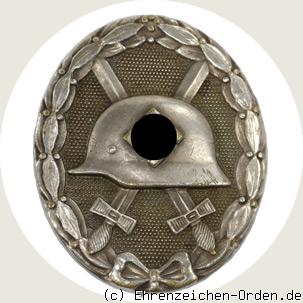 Obverse: 1939 Wound Sign in Silver (2nd Uniform
)
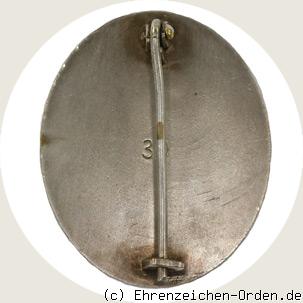 Reverse: Sign for the 1939 wound in silver (2nd form)
Established:
September 1, 1939 Adolf Hitler
Data:
- Material: Tombak silver plated
- Size: 43mm x 37mm
- Weight: 31.4g
estimated collector price:
90 - 100 € in silver-plated non-ferrous metal
70 - 80 € silver-plated in zinc

 Awards of World War II