Germany Awards - 1st Class Eastern Peoples Merit Award
The award for bravery and merit was established on July 14, 1942 by Adolf Hitler. Representatives of eastern peoples who were in the auxiliary service of the Wehrmacht and distinguished themselves by exemplary performance of duty were awarded. The award became necessary because local volunteers and defecting Red Army soldiers became increasingly involved in the struggle on the German side during the war. According to Nazi ideology, the circle of persons could not be awarded the Iron Cross, because the eastern peoples were considered inferior. The award was given for bravery (military merit) with swords and for general merit without swords. The award consisted of 2 classes. 1st class was awarded as a cross-pin in silver and gold, 2nd class on a ribbon in bronze, silver and gold, each with and without swords. 2nd class could be awarded repeatedly up to 3 times.
Since October 1944, servicemen of the German Wehrmacht could receive this award only as a memorial sign. The prerequisite for this was direct activity in the unions of the eastern peoples and the awarding of the Iron Cross. The 2nd class of the Iron Cross was entitled to be awarded the Eastern national insignia of the 2nd class in silver, the 1st class of the Iron Cross - to be awarded the Eastern national insignia of the 1st class in silver. The corresponding level was awarded only once. Because the award was for gallantry or combat use, classes could also only be awarded with swords.
A cross made of silver-plated zinc in the form of an 8-beam radial crown. In the center in front is a round shield. On the back side in the center is an arched round central part and a vertical pin.
Front side:
- 8 rays each at a distance of 45 ° are elongated
. There are 3 - stepped smaller beams between them.
- A round central shield with a wide ring inside and out is bordered by raised edges.
- Which is in the form of a rope or cord. In the ring, a leaf wreath with fruits tied from below.
In - a closed field, an image of a 6-lobe socket as a sun wheel.
- Rotating the leaves counterclockwise. In the center is an elevated point.
Downside:
- The radial wreath, as well as the central shield, are smooth and silver-plated.
- The central shield is slightly curved outward.
Photos of www.militaria-berlin.de
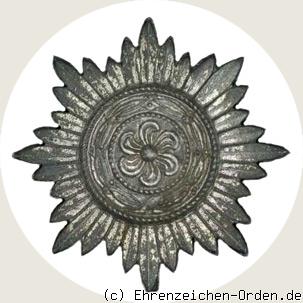 Front: Merit Award for Eastern Peoples 1st Class Silver
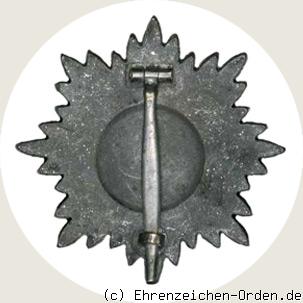 Reverse: Merit Award for Eastern Peoples 1st Class Silver
Established:
July 14, 1942 Adolf Hitler
Data:
- Material: silver-plated zinc
- Size: 49mm
- Weight: 24g
estimated collector price:
190 – 210 €

 Awards of World War II