German Awards - Front slats for transport and landing aircraft in bronze
Front-line flight brackets were established by the Luftwaffe Commander-in-Chief German Goering on January 30, 1941 in 3 stages, as a visible sign and recognition of the probationary period when using the front in the air. At the same time, this should stimulate the flight personnel to fulfill their duties. Initially, front-line aviation brackets were donated to fighter, fighter and combat formations, combat and airborne transport and airborne formations and reconnaissance formations. They also included maritime reconnaissance teams and meteorological teams. Depending on the front-line flights, the screed was awarded in bronze after 20 flights, in silver after 60 flights and in gold after 110 flights. All departures that have passed at least 30 km beyond the front line, or flights associated with contact with the enemy, are considered front-line. Long flights over 12 hours were counted 4 times, and over 16 hours - 5 times. In 1944, front-line flight brackets were expanded to 8. Now in flight there were clamps for the following pilots: fighters, short-range night fighters, long-range night fighters, combat and falling combat aircraft, scouts, transport and landing aircraft, combat aircraft and destroyers. Front planks for transport and landing aircraft were subject to special regulations. Due to frequent overfulfillment of tasks on June 26, 1942, the star (suspension) was presented to the golden front span. Since April 29, 1944, these trailers have been awarded hundreds of steps.
Wide clasp of bronze tinted tombac. The eagle is separately beveled and old silver. At the back is a horizontal pin.
Front side:
In - the center of the screed is round, a wreath tied from below, consisting of bay leaves.
In - it is a silver-plated eagle flying to the right from the side,
in - catching a swastika set on a point, punching gaps.
- To the left and right of the wreath are oak leaves in 4 rows - 3 - 3 - 2 - 1 - leaf
Downside:
 Awards of World War II
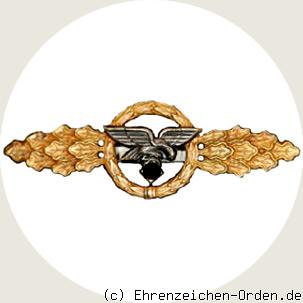 Front end: Front suspension brackets for transport and landing aircraft in bronze
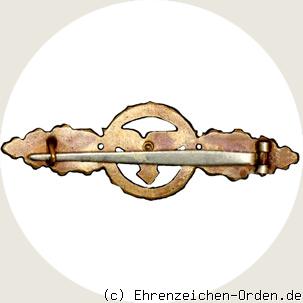 Reverse: Front braces for transport and aircraft in bronze