Germany Awards - Forward bar for destroyers in gold
Front flight brackets for destroyers are equal in design to brackets for long-range night fighters. The difference is in the black wreath of night hunters. It was awarded to the flight personnel of special associations of destroyers in gold, silver and bronze. The bronze front bar was awarded after 20 enemy flights, the silver after 60 flights and the gold front bar was awarded after 110 enemy flights. Presented on June 26, 1942, a star (suspension) to the golden front belt was awarded to fighter pilots after at least 400 front-line flights. Then, from the end of April, trailers with bet numbers in hundreds of steps were awarded. Enemy flights included flights at a distance of at least 30 km beyond the front line or associated with contact with the enemy. Later long flights, over 12 hours were counted 4 times, and over 16 hours - 5 times. Front flight brackets were expanded to 8 versions by 1944. These were: fighters, short-range night fighters, long-range night fighters, scouts, combat and dive fighters, transport and landing aircraft, combat aircraft and destroyers. The main producer is G. H. Osang from Dresden. There are also frontline aircraft for combat aircraft without a manufacturer or with manufacturer R.S. & S., Richard Simm and sons from Gablonz on the Neisse. Braces were made of tombac or fine zinc. Source: J. Nimmergut, Deutsche Orden und Ehrenzeichen bis 1945, vol. 4, 2001.
Wide gold plated zinc openwork clasp. The winged arrow is separately inclined and ancient silver. At the back is a horizontal pin. For clips with the manufacturer, this is on the back.
Front side:
In - the center of the clasp is a round wreath consisting of bay leaves.
- Below on the laurel wreath is a straight-standing swastika.
In the - center of the wreath is an ancient silver-plated patinated winged arrow with its tip pointed down.
- To the left and right of the wreath are oak leaves in 4 rows - 3 - 3 - 2 - 1 - leaf
Downside:
- Smooth and gilded.
- There is no manufacturer here. If with the manufacturer of this on a screed.
Photos of www.militaria-berlin.de
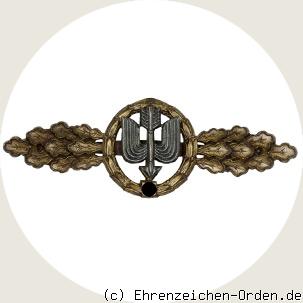 Front end: Front bar for destroyers in gold
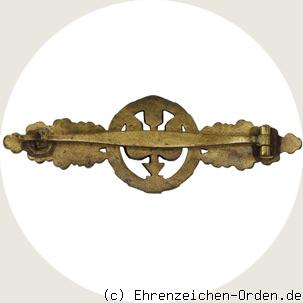 Reverse: Front bar for destroyers in gold
Established:
January 30, 1941 Hermann Goering
Data:
- Material: gold-plated zinc
- Size: 75mm x 25mm
- Weight: about 18g
estimated collector price:
1200 – 1400 €

 Awards of World War II