German Awards - Badge of Honor of the German Red Cross 1922 Cross 2. That is sick
The badge of honor of the German Red Cross was established by a decision of the general meeting on April 28, 1922 in 2 classes. 1st class as neck cross and 2nd class on ribbon and women's loop respectively. However, the announcement and awarding dragged on until 1924. Only on February 15, 1924 the fund was announced. The badge of honor was to be clearly different from the previously awarded medal of the Red Cross of Prussia and was awarded only for merits in the time of foundation. The badge of honor must be awarded very sparingly to ensure a high reputation. The award was presented as the highest award of provincial clubs and provincial federations for special services to the cause of the Red Cross. All other merits should be marked with honorary signs of land associations. The awards have been presented by the President of the DRC since 1926 under the patronage of the Reich President. The most famous manufacturers were Godet & Sohn, J. H. Werner and P. Meybauer from Berlin. Due to the short rental period and economical award, crosses are very rare. Source: Manfred Schemeit, badge of honor of the German Red Cross 1866 - now.
A gilt bronze cross in the shape of the Geneva Cross. Straight cruciform arms are sheathed in gold and enameled in white. The front side with a round, raised middle shield. On the upper cruciform shoulder is a pupate ear with a ribbon ring.
Front side:
- Round central shield with gold border. Outside is a wide black enameled ring.
- It has a golden inscription: above - DEUTSCH - below - ROTES - KREUZ -.
- Center left and right between them is a dot. Ring inside with gold border.
In - a closed field on a white enameled background is a red golden burgundy Geneva cross.
Downside:
- Smooth and white enameled without a central shield.
Tape:
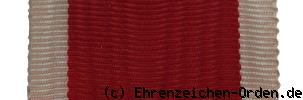
- red 30 mm wide, white edge stripes 5 mm.
.
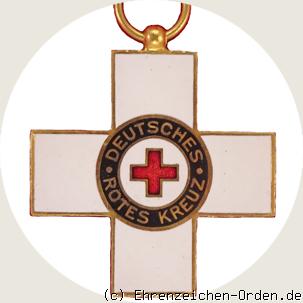 Obverse: Badge of Honor of the German Red Cross 1922 Cross 2. That is sick
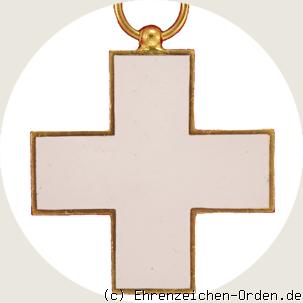 Reverse: Badge of Honor of the German Red Cross 1922 Cross 2. That is sick
Established:
April 28, 1922 by the German Red Cross
Data:
- Material: gold-plated bronze, enamel
- Size: 40.2mm
- Weight: 16.12g
estimated collector price:
110 – 140 €

 Awards of World War II