German Awards - Traditional Gauabel Thuringia in Bronze
This traditional Gausian Thuringian mark in bronze is not mentioned in the special literature, although they also occur with the matrix number. Angola in silver and gold, but not in bronze. The question of whether there were gradations in the traditional Gauabel should remain open. On June 17, 1933, Gauleiter Fritz Sauckel established the traditional Gaukel sign for Thuringia. The reason is the recognition of merits in the struggle for the Third Reich. From the award documents, it can be concluded that the Silver Gau Badge was awarded to 1,000 of the oldest fighters in Gau Thuringia. On the certificate of ownership, the number of the party member was indicated, as well as the number of the lot of the badge. At the same time, it was considered a right to wear. The seal of the certificate of possession comes from R. Borkman of Weimar. The icon of the Thuringian Gautelfrasse collection in Erfurt is used as a model. Originally scheduled awards of only 1,000 members cannot be confirmed based on validated matrix numbers. Found icons with numbers higher than 1400. Source: Jörg Nemmergut, German Orders and Badges of Honour until 1945, vol. 4.
A hollow embossed copper alloy sign in the form of a stylized eagle. In the paws right standing swastika. The back side with a horizontal pin with mating hooks.
Front side:
- Head eagle to the right. The left wing is flat with 7 stylized feathers.
- The right wing is directed downward with stylized 4 feathers.
- The horizontal swastika is held laterally by 3 claws.
- There is a raised font on the cross sleeves: at the top - N - ° - S - ° - D - ° A - ° - P -.
- Central (large) - FOR - LOYALTY -, lower (smaller) - TURING. –
- Bottom right next to the cross 4 stylized tail feathers
Downside:
- Negative front.
- On the right on the cross, the matrix number is 700 -.
- Horizontal flat pin with mating hooks.
.
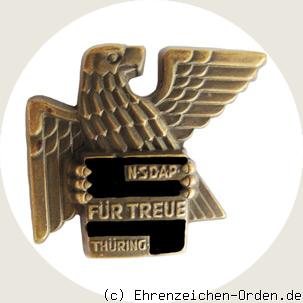 Obverse: Thuringia's traditional Gausian sign in bronze
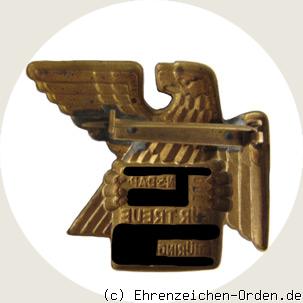 Reverse: the traditional Gausian sign of Thuringia in bronze
Established:
June 17, 1933 Gauleiter Fritz Saukel
Data:
- Material: copper alloy
- Size: 39.2mm x 47.2mm
- Weight: about 12g
estimated collector price:
1400 – 1600 €

 Awards of World War II