German Awards - World War I Cross of Honor
The World War Cross of Honor was established on the initiative of Reich President Paul von Hindenburg on July 13, 1934. This was the first state award in memory of the 1 World War. (unofficial, but tolerant) The World War Cross of Honor was awarded at will in 3 versions: the Cross for front-line soldiers, the Cross for war veterans, the Cross for survivors (widows and parents). However, only one version can be requested. The cross was issued by city authorities, police or other government agencies. The cross was awarded a total of about 10,000,000 times in 3 forms and therefore was not uncommon. There are many manufacturers with different markings. Crosses were made mainly of iron, and then bronzed. Crosses made of non-ferrous metals such as brass and bronze are specimens distributed through trade. Crosses were awarded with a letter in a bag. Blue bags were prescribed for front-line fighters. In trade, it was possible to purchase sketches with the inscription "Loyalty for loyalty" and a facsimile of Hindenburg's signature. Front-line soldiers were all Germans who participated in a battle, skirmish or positional battle. Later, the circle of persons eligible for receipt was expanded to the Austrians, the Saarland and the territories annexed to it, such as the Sudetenland and Memeland. Foreign persons who were Wehrmacht servicemen could also be awarded. Since August 18, 1934, crosses have been awarded on behalf of the Fuhrer and Reich Chancellor. Source: J. Nimmergut, Deutsche Orden und Ehrenzeichen before 1945, vol. IV, 2001.
Bronze iron cross with border. In the center is a medallion. Through the middle are crossed 2 swords. Above is a corrugated embossed ear with a ribbon ring.
Front side:
In the - center is a round medallion along the edge, consisting of a laurel wreath tied at the bottom.
In - a closed field, annual figures are among themselves: - 1914-1918. -
Downside:
- Smooth bronze with manufacturer's signature.
In - this regard 32/R.V. PHORZHEIM, Working Group No.
Tape:
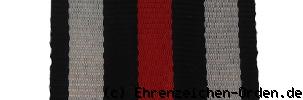
- Width 31 mm, edging black 1 mm, side stripes white 6 mm, central stripes black/red/black 5 mm each.
.
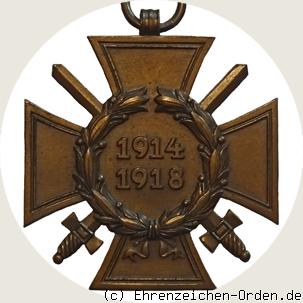 Obverse: World War I Cross of Honor
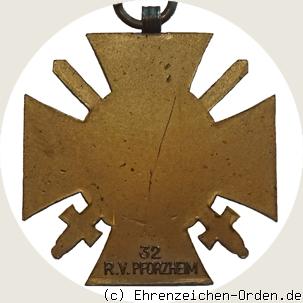 Reverse: World War I Cross of Honor
Established:
July 13, 1934 Reich President Paul von Hindenburg
Data:
- Material: Bronzed iron
- Size: 37mm
- Weight: about 13.5g
estimated collector price:
10 - 20 € in iron brunette
70 - 90 € in bronze

 Awards of World War II