German Awards - German Order of the Eagle Cross 2. Class/3. That is sick
The Order of Merit for the German Eagle was established on May 1, 1937 by Reich Chancellor Adolf Hitler. This award was created to honor foreign citizens who earned money from the German Empire. Reich Foreign Minister Konstantin von Neurath made proposals (from 4.2.1938 Joachim von Ribbentrop). The order had 5 degrees: Grand Cross, Cross of Merit with a star as a neck decoration, Cross of Merit 1. Level also as neck decoration, cross of merit 2. The Meritorious Service Cross and 3rd Class Meritorious Service Cross are attached to the ribbon with a silver meritorious service medal. On April 20, 1939, a special degree of the Grand Cross was established in gold. 8 awards are known. At the same time, swords were awarded for military merits. The last change occurred on December 27, 1943. The order was reclassified in 1943 and supplemented with a bronze medal "For Merit." Now it consisted of 5 classes (previously 3 tiers), a large cross, 1st class with a breast star (8 rays), 2nd class with a breast star (6 rays), 3rd class (like 2. class without breast star), 4th class (pin cross), 5th class on ribbon and silver and bronze medals "For Merit." For the assignment of individual classes, the rank or service rank was decisive. Early crosses as the German Eagle Order of Merit had the usual band ring eyelet. Crosses as of 1939 had an agraf with an eye and a ribbon ring. Therefore, this cross is a cross of the 2nd class or 3rd class, and not a cross of merit. 2nd class was awarded to persons with the rank of lieutenant general, vice admiral, major general or rear admiral. For civilians, the directive applied: to the councils of lecturers, the councils of ministers, the councils of the legions, the highest government councils, or to outstanding professors. In addition to foreigners, only 2 Germans, foreign ministers and the imperial protector in Bohemia and Moravia wore the Grand Cross of the order. The order was awarded not on merit, but on service signs. Awarding took place on the principle of reciprocity. For political and other reasons, the following were removed from the award: the Soviet Union, Lithuania, Czech Republic, Slovakia, Poland, Austria, Norway, USA, Switzerland, Ireland, Great Britain, France and states with unofficial missions. The first samples were manufactured by Godet, Berlin. The manufacturer was then first Deumer, Lüdenscheid. The author of the project is Professor Klein. Source: J. Nimmergut, Deutsche Orden und Ehrenzeichen before 1945, vol. IV, 2001.
Silver gilded cross in the form of ioannite. The cruciform arms are maroon golden and enameled white. Between the cross sleeves is accordingly a golden imperial eagle facing the left with its wings lowered. There is an oak wreath in the catches. In the center of which is a swastika placed on top. The base is enameled white. Between the tops of the upper cruciform shoulder is an agraff with a parallel ear. Through them passes an elongated, expanding upward, 2-fold corrugated ribbon ring. On the ear are silver stamps 900 and 21 for Gaudet/Berlin.
Front side:
- So is the back. The Eagles look left.
Downside:
- Like the front. The Eagles look right.
Tape:
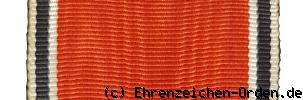
- red 45 mm wide, edge strips white/black/white 1 mm/2 mm/1 mm.
Photos of www.militaria-berlin.de
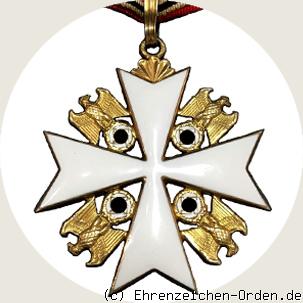 Obverse: German Order of the Eagle Cross 2. Class/3. That is sick
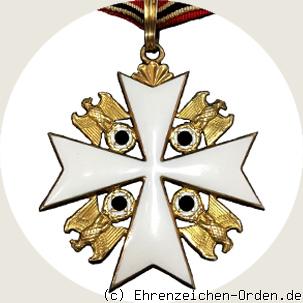 Reverse: German Order of the Eagle Cross 2. Class/3. That is sick
Established:
May 1, 1937 Adolf Hitler
Data:
- Material: Silver, enamel
- Size: 50mm
- Weight: About 26g
estimated collector price:
2200 – 2400 €

 Awards of World War II