German Awards - Imperial Artillery Badge 1913
Emperor William II. established the imperial badge on January 27, 1895. In the kingdoms of Saxony, Württemberg and Bavaria, royal insignia were introduced by analogy. The sign served as an incentive and encouragement for achievements in shooting. Imperial insignia were donated to infantry, hunters and riflemen and artillery. In 1903, another insignia was introduced for machine gun units. Every year in the corresponding army corps, the company or battery that was recognized as the best in terms of general indicators was awarded. The badge was awarded annually from 1895 to 1913. The badge was worn on the right forearm of the uniform by the entire awarded crew. Over the years of the award, there have been several awards for the same troops. By 1902, numbers began to be placed under the badge already worn. Since October 31, 1902, on a ribbon entwined with an oak wreath, the figures for re-awarding began to be knocked out. The imperial badge of artillery was awarded to the same unit up to 3 times. The imperial artillery badge in 1913 received the 1st Guards Field Artillery Reg., 1st Kurges Field Artillery Reg. No. 11, King Charles Field Artillery Regiment (1st Württemberg) No. 13, 2nd Pomeranian Field Artillery Regiment No. 17, Lower Saxon Field Artillery Regiment No. 46, 2nd Upper Silesian Field Artillery Regiment No. 57, Baden Foot Artillery Regiment No. 14 and Mindensh Field Artillery Regiment No. 58
Standing oval badge in gilded brass. The middle of the sign is openwork. Soldered on the rear side 6 is a fastening cotter pin which is inserted through the mating plate. The badge is inscribed on the uniform.
Front side:
- The edge is formed by a wide oak-leaved wreath.
- Below it is tied in a loop. From above it is completed by the imperial crown.
- Above the loop is the corresponding year, here - 1913 -
- Resting on the wreath 2 with cannon pipes crossed by the middle.
Downside:
- A soldered cotter pin was stuck through the counter-plate.
- The sign is hollow. Cover plate and cotter pin are covered with cloth.
.
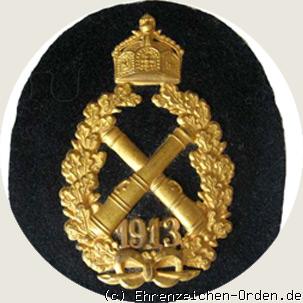 Obverse: Imperial Badge of Artillery 1913
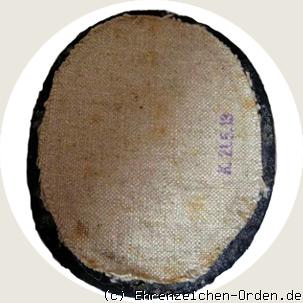 Reverse: Imperial Badge of Artillery 1913
Established:
January 27, 1895 by King and Emperor William II
Data:
- Material: gold-plated brass, sheet, fabric
- Size: 54mm x 90mm, back panel 87mm x 46mm
- Weight: 25g
estimated collector price:
140 – 160 €

 Awards of World War II