 Awards of
World War II
Awards of
World War IIThe Silver Star Medal is one of the highest military awards of the United States Army, awarded to soldiers and officers of both the U.S. Army and allied armies for valor or other heroic actions in the fight against the enemy.
Materials
Bronze, gold plated, silver plated.
Artist
Bailey, Banks, and Biddley
Awarded to
Service members of the U.S. Army and its allies.
Reasons for awarding
Committing a feat of valor or other Heroic actions that cannot be recognized by a higher award.
General Douglas MacArthur received the Silver Star Medal, No. 1, with six oak leaf clusters on the ribbon, in 1932. In the U.S. Navy, the first award was made on July 27, 1942, posthumously to Clarence Aschenbrenner, a second-class officer who was mortally wounded while attempting to rescue members of his ship's crew.
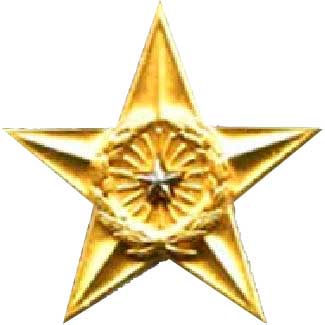
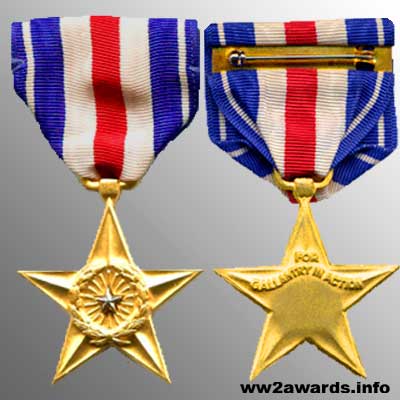
The Silver Star Medal is one of the highest military decorations, awarded for exceptional heroism in action against the enemy, but which cannot be recognized by a higher award. Early versions of this award appeared as early as 1918, but at that time it was not a stand-alone award, but rather attached to the award ribbon as a badge of distinction. The award acquired its current form in 1932, when its statute was developed. Furthermore, the statute provided for the possibility of replacing previously issued Silver Star badges with the new medal. The medal is a gilded five-pointed star. In the center of the star is a small silver star, from which stylized sun rays extend, bounded by a circle resembling a laurel wreath. On the reverse of the "Silver Star" medal is a space for engraving the recipient's name and the inscription "FOR COURAGE IN BATTLE." The medal is attached with a loop to a pentagonal ribbon bar covered with a blue moiré ribbon, with a red and two white stripes in the middle.