 Awards of
World War II
Awards of
World War IIThe medal is intended to award soldiers and officers of the United States Navy and Marine Corps for courageous acts and other outstanding actions not involving direct combat with enemy forces.
Materials
Bronze.
Artist
Barclay McClelland, John R. Sinnock, M.A. Crawford.
Awarded to
Servicemen of the US Navy, Marine Corps and their Allies.
Based on the Award
For outstanding actions and courageous deeds while serving, not involving direct combat with enemy forces.
Awards of the US Navy and Marine Corps Medal have been held since December 6, 1941. One of the recipients during World War II was future President of the United States John F. Kennedy.
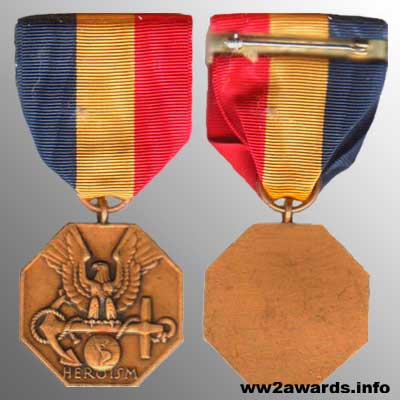
The medal for awarding soldiers and officers of the Navy and Marine Corps was designed by artists Barclay McClelland and John Sinnock in 1941, and was approved by an act of the US Congress on April 7, 1941. Essentially, this award is similar to the land-based Soldier's Medal; it is also intended to reward heroic deeds not involving direct combat with enemy forces.
The medal itself is a hexagonal medallion. The obverse depicts an eagle with its wings spread upward, perched on a ship's anchor, around which a rope is entwined. The anchor rests on an image of the globe, facing North and South America, with the inscription "HEROISM" below. The reverse of the medal is used for engraving the recipient's name. The Navy and Marine Corps Medal is attached to a ribbon with a tab: blue, yellow, and red.