 Awards of
World War II
Awards of
World War IIThe Distinguished Flying Cross is an award given to members of the United States Air Force for extraordinary action or heroism during flight.
Materials
Bronze
Artist
Arthur DuBois and Elizabeth Vill.
Award recipient
Enlisted personnel and officers of the United States Army, Navy, Air Force, and Coast Guard, as well as their allies.
Reasons for awarding
For heroic action and exceptional courage during aerial flight.
The award was established by the U.S. Congress in 1926. Initially, the Distinguished Flying Cross was awarded to aviators who set records, with Charles Lindbergh being the first recipient for his flight across the Atlantic. However, since 1927, following a decree by the President of the United States, this award has been given exclusively military status.
As a military award, the Distinguished Flying Cross could be awarded to soldiers and officers of the United States and Allied countries who performed an outstanding or heroic act that clearly distinguished the recipient from other participants in the event.
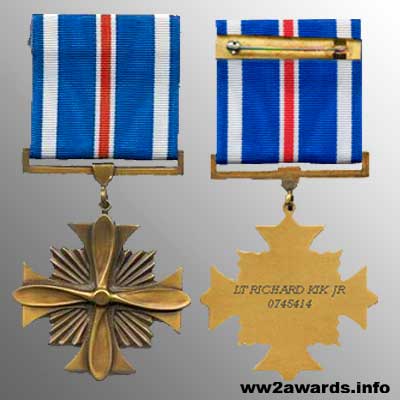
The award is an equilateral cross with flared edges, on which is superimposed a four-bladed airplane propeller, with sunrays radiating from beneath the cross to form a square. The reverse of the Distinguished Flying Cross is flat and engraved with the recipient's name. The cross is attached with a loop to a ribbon bar, to which is attached a blue moiré ribbon with a red stripe in the center and two white stripes closer to the edges.