 Awards of
World War II
Awards of
World War IIThe highest military decoration of Great Britain, awarded for extraordinary heroism in action against the enemy, to soldiers and officers of the British Army, Royal Navy and other Allied armies who have performed outstanding actions in action, in the interests of the British Crown.
Materials
Bronze
Manufacturer
Jewelry company "Hancox"
To whom it is awarded
Servicemen of the armed forces of the British Army, Royal Navy, as well as servicemen of other armies of the Allied countries.
Grounds for the award
For extraordinary heroism shown in battle.
The Victoria Cross was established by decree of Queen Victoria on January 29, 1856. The first award ceremony took place in Hyde Park on June 26, 1857. The cross was awarded to 62 knights of this order for outstanding service in the Crimean War; the award was presented by Queen Victoria. During World War II, 181 people were awarded the Victoria Cross.
This award was established during the Crimean War as Britain's highest military decoration. According to legend, all Victoria Crosses were made from Russian cannons that defended Sevastopol and were captured by England. This metal is stored in a vault in Donington and is transported only in exceptional cases. The last time Hancox received metal was on October 23, 1959, in the amount of 50 ounces (1,417.5 grams), enough to make 12 crosses. Furthermore, it is known that 358 ounces (10,149.1 grams) remain in the vault, which is enough to make another 85 Victoria Crosses. The fact that all the crosses are made of this metal was questioned by employees of the Tower of London, who conducted a fluoroscopic analysis of the 1918 award; it turned out to be made of ordinary bronze. Apparently, during the First World War, there were some cases of crosses being made of simple bronze.
Initially, the award was presented only to surviving soldiers, and in 1902, posthumous awarding of the Victoria Cross was legalized. Since 1920, the award has remained with the recipient, regardless of their crimes. King George V, who introduced this change, commented, "Regardless of the crime committed, no recipient of the Victoria Cross should be deprived of his distinction. Even a man sentenced to hang for murder should be allowed to wear his Victoria Cross on the scaffold."
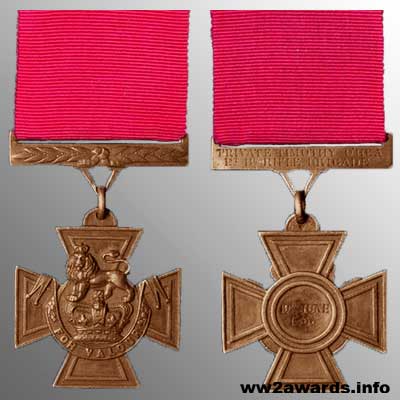
The award itself is designed as a cross pattée (the rays narrowing toward the center). In the center of the award is a British crown with a lion on it. Below the crown is a ribbon bearing the inscription "For Valor." The reverse of the Victoria Cross is engraved with the date of the heroic deed. The award is attached to a ribbon bar covered with a crimson moiré ribbon using a loop and ring. The recipient's name, rank, and military unit are engraved on the reverse side of the bar.