 Awards of
World War II
Awards of
World War IIThe Commonwealth Award – Star 1939-45 was created for all those who served between September 3, 1939 and September 2, 1939 and contributed to the great victory over the aggressors.
Materials
copper, zinc.
Award recipient
Persons who served during World War II.
Reasons for award
Service for one month in a combat zone (outside the UK). Six months of service in the navy and at least one voyage through a combat zone. To personnel of the Royal Observatory Service Corps for service of at least 1,080 days.
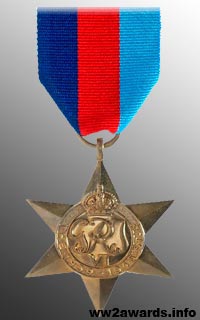
The award is a six-pointed star made of copper and zinc. The star is 44 mm high and 38 mm wide.
On the obverse of the award, the star is centered on a round medallion bearing the monogram of King George VI. The monogram is surmounted by a royal crown, with the inscription "Star 1939-1945" around the circumference. The reverse side is plain; the recipient's name was engraved only for the Australian and South African military.
The ribbon consists of three vertical stripes of dark blue, red, and light blue. The dark blue stripe symbolizes the Navy and Merchant Marine, the red stripe represents the Army, and the light blue represents the Air Force. All three stripes are equal in width, symbolizing the equal contribution to victory of the Navy, Army, and Air Force.
The award ribbon may be equipped with a clasp in the shape of the Rose of Lancaster. If made of gilt silver, this award was received for the Battle of Britain. The award criterion was participation in defensive air battles from July 10 to October 31, 1940. If made of silver, it is awarded to bomber crews who participated in at least one air raid.