 Awards of
World War II
Awards of
World War IIOne of the highest awards for the British Air Force is the Distinguished Flying Cross (DFC) awarded to members of the Royal Air Force and airmen of other nations for actions or acts of valor, courage, or devotion to duty while flying in active service against enemies of the British Crown.
Materials
Silver.
Author
Edward Carter Preston.
Awarded to
Members of the Royal Air Force and Allied Air Forces.
Reasons for the award
For an act of valor, courage, and Dedication to duty during flight.
During World War II, 20,354 people were awarded the Distinguished Flying Cross, approximately 1,550 were awarded twice, and 45 were awarded three times. Among those awarded were 964 Allied aircrew members.
The award was instituted on June 3, 1918, almost immediately after the formation of the British Air Force. Initially intended to be awarded to officers and warrant officers of the Royal Air Force of the British Empire, it was later extended to include airmen of the Army and Naval Aviation.
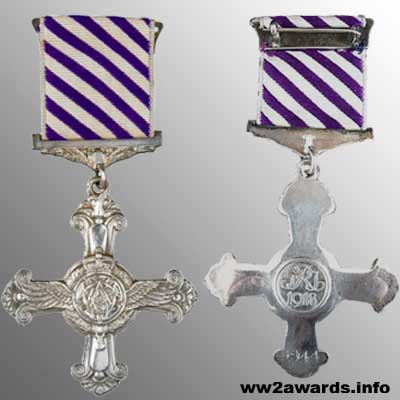
The award is made of silver in the form of a Florey Cross, 2.125 inches wide. The horizontal and lower ends of the cross are rounded, and the upper end is adorned with a rose. The vertical arms of the cross are decorated with propeller blades, while the horizontal arms are adorned with wings. The center is adorned with the RAF monogram, surrounded by a laurel wreath, surmounted by an imperial crown. On the reverse of the Distinguished Flying Cross, the King's monogram is placed in the center, and the year of award is engraved on the lower arm. The award is attached to a ribbon bar consisting of diagonal purple and white stripes. Repeat awards are marked by silver pins in the shape of the Rose of Lancaster, attached to the ribbon bar.