 Awards of
World War II
Awards of
World War IIThe Medal for Those Honored on the Field of Glory was established by order of the commander of the First Infantry Division named after Tadeusz Kosciuszko, Brigadier General Zygmunt Berling. The exact date of the award's establishment is unknown, but it is believed to have been late October or early November 1943, as the first recipients were those who participated in the Battle of Lenino on October 12-13, 1943, and were awarded the medal on Poland's Independence Day, November 11, 1943. The medal was finally approved by a decree of the Polish Committee of National Liberation on December 22, 1944.
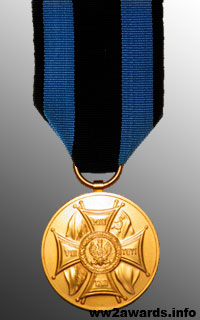
The award was established in three classes: gold, silver, and bronze, as a medal for courage, valor, and heroism in combat under particularly difficult conditions requiring self-sacrifice. The medal's regulations were modeled after Soviet awards and detailed the actions for which a soldier received the award and the level of the award.
To receive the gold medal, one had to:
- destroy two enemy aircraft in combat;
- commission and participate in combat on a captured enemy aircraft;
- destroy three tanks or three enemy guns in combat;
- kill at least 100 enemies with a sniper rifle;
- evacuate at least 50 wounded during combat.
A silver medal was awarded for direct assistance in performing the actions required to receive a gold medal, so if in In a pair of fighters, the leader received a gold medal, but the wingman was practically guaranteed to receive a silver one.
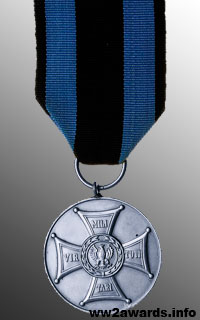
The criteria for the bronze medal were more vague; it was awarded for exemplary execution of an order and the completion of a combat mission, while demonstrating perseverance, initiative, and courage that serves as an example to others.
The medal can be awarded repeatedly, up to four times, in which case the medal is not issued, but instead The recipient received a ribbon bar and a document confirming the repeated award. The medal is also awarded to foreign citizens who contributed to the victories of the Polish Army.
By the end of 1945, 57,063 awards of the "Honored on the Field of Glory" medal had been made, including 36 gold, 16,656 silver, and 40,371 bronze. On December 23, 1992, the medal's awarding ceased, and it was removed from the current Polish awards system. By 1992, 111,390 awards had been issued, including 38 gold, 35,749 silver, and 75,603 bronze.
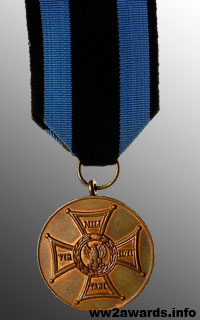
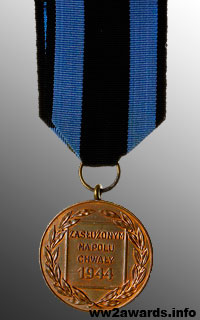
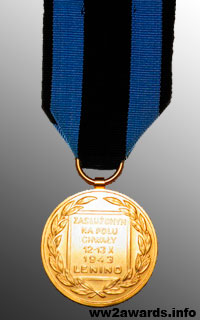
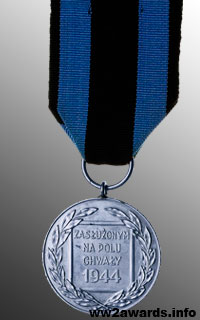
The first version of the medal was a circle with a diameter of 40 mm and was minted at the Moscow Mint. The obverse of the award depicts the Order of Virtuti Militari, with a crowned eagle, superimposed on the crossed national flags of the USSR and Poland. On the reverse, within a rectangular frame measuring 24 x 20 mm and surrounded by a wreath, is the six-line inscription: ZASŁUŻONYM / NA POLU / CHWAŁY / 12–13 X / 1943 / LENINO (To those honored on the field of glory on October 12–13, 1943, Lenin). A second version of the award, minted in Warsaw at Bronisław Grabski's factory, was issued in late 1945. The second version differed in that the eagle on the order lacked a crown. The crossed banners were also removed from the obverse, and the reverse bore a four-line inscription: ZASŁUŻONYM / NA POLU / CHWAŁY / 1944 (To those honored on the field of glory 1944). Both the first and second versions of the award were later awarded. The first version was made of gold, silver, and tombac, while the second was made of tombac or bronze with gilding or silvering. The award ribbon is a 42 mm wide silk moiré ribbon. The ribbon colors are the same as those of the Virtuti Militari Order, but reversed, with the blue stripes being 10 mm wide. A 5 mm wide ribbon bar for repeated awards was made of the same material as the award itself and decorated with an embossed oak leaf motif radiating from the center.