 Awards of
World War II
Awards of
World War IIThe award was established by a decree of the Polish government-in-exile on October 19, 1942. The same decree amended the regulations for the Cross of Merit of June 23, 1923.
The decree establishing the award of October 19, 1942, states "... in order to encourage acts of courage and bravery demonstrated in particularly dangerous conditions directly on the battlefield, as well as for services to the state during the war, establish the Cross of Merit with Swords."
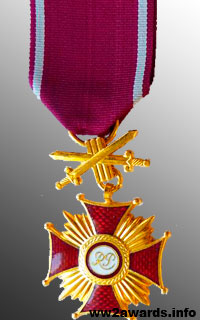
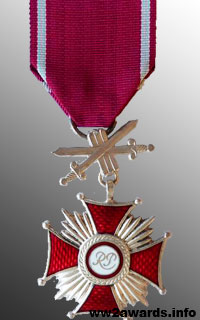
The award was established in three classes: Gold, Silver, and Bronze, the highest class being the Cross of Merit with Swords. is Gold.
Each class of the award could be awarded no more than four times. In the case of repeated awards, instead of the award itself, a ribbon bar and a document confirming the repeated award were issued.
According to the award's regulations, it could be awarded to both Polish and foreign citizens.
The Supreme Commander of the Polish Armed Forces had the right to award the Cross of Merit with Swords.
The gold version of the award was intended exclusively for officers, however, there are known cases where it was awarded to junior commanders and privates for outstanding service.
In total, the Cross of Merit with The following were awarded with swords: Gold - 114, Silver - 540, Bronze - 2,572.
The award is made in the form of a cross with expanding rays, at the ends of which are balls. The rays of the cross on the obverse have a scaly surface and are filled with translucent red enamel. In the spaces between the rays of the cross are sunrays diverging from the center, five in each space. In the center of the cross is a medallion surrounded by two rings; the outer ring is decorated with an ornament, the inner one is covered with red enamel. The center of the medallion is filled with white enamel, in which are metal letters "RP." Attached to the upper arm of the cross, through an eye and ring, are two crossed swords, pointed upwards, which in turn are attached to the award ribbon through a ring. The reverse of the award is flat. All surfaces not covered with enamel are gilded in the gold version and silver-plated in the silver version.
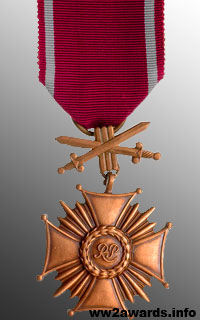
The bronze version of the award is made entirely of bronze, without enamel coatings. It differs from the two older versions in that it has sun rays in the spaces between them, three on each side, and in the frame of the central medallion, which is designed as a wreath of laurel leaves.
There is also a version of the award made by the Polish underground in occupied territory. Its distinctive feature is that two crossed swords, passing through the center of the cross, are superimposed on the diverging sun rays. The center of the award, instead of the letters "RP," is decorated with an image of the royal eagle, and the right and left rays The cross bears the date 1943. This version of the award also features different swords in the pendant, echoing the design of the swords on the pre-war Independence Cross.
The dimensions of all degrees of the cross are 40 x 40 mm, the central medallion (wreath) is 18 mm, and the swords are 35 mm long.
The award ribbon is a dark red silk moiré ribbon with two longitudinal light blue stripes on each side. The ribbon is 40 mm wide, the light blue stripes are 3 mm wide, and the stripes are 1 mm from the edge.
The repeat award bar is 8 mm wide and decorated with oak branches radiating from the center. The bar material matches the award material.
The Cross of Merit is worn on the left chest and, if other awards are present, is placed after the Brave Cross.