 Awards of
World War II
Awards of
World War IIIn 1938, a new wound badge was developed and instituted in the Japanese army, radically different from its predecessor.
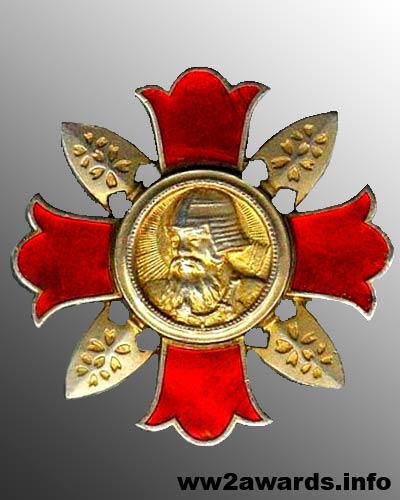
The award became unified for soldiers and officers, but retained two varieties: one for a wound received in combat, and one for a wound received in government service, outside of combat (the second type of award was also awarded in the event of a serviceman contracting a serious illness, such as malaria).
The award is designed in the form of two crossed classic Samurai shields, forming a cross measuring 32 x 32 mm, are covered in ruby-red enamel. Arrowheads are inserted into the spaces between the arms of the cross. In the center is a round medallion, 15 mm in diameter, depicting Kusunoki Mesashige, a legendary samurai and hero of Japanese history.
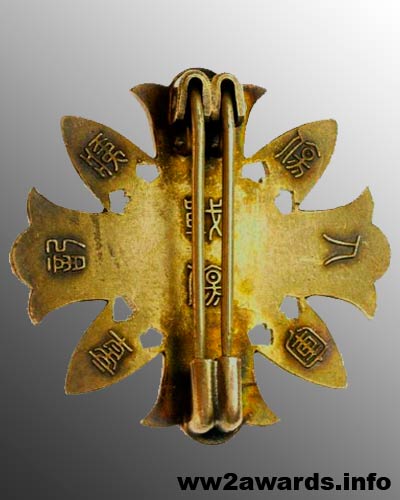
On the reverse of the wound badge, on the three right and left arms, is the inscription in hieroglyphs: "Military wound badge." In the center is an inscription indicating the type of badge: "Sense" - for a wound in battle, or "Kose" - a non-combat wound. The reverse of the badge has a two-pronged pin for attaching to clothing and is worn on the lower right chest.
Both badges are made of silver, except for the Sense (for a combat wound) badge, which is gilded. Towards the end of World War II, badges were made from alloys containing only a small amount of silver.