 Awards of
World War II
Awards of
World War IIThe Order of the Golden Kite was established on February 12, 1890 by order of Emperor Meiji in honor of the 2550th anniversary of the reign of the Jimmu dynasty. The award was abolished by the government, at the insistence of the Supreme Commander of the Allied Powers in occupied Japan, in 1947.
Materials
silver, gilding, enamel.
Dimensions
1-2 class 76*81 mm; 3 class 56*60 mm; 4-5 class 46*50 mm; 6-7 class, 42*57 mm.
The Order of the Golden Kite was a purely military award, bestowed for bravery and decisive actions in battle and skillful troop leadership. In the Japanese awards system, it ranked just below the Order of the Chrysanthemum and was the military equivalent of the Order of the Paulownia Flower.
The award had seven classes. Generals were awarded classes 1-3, senior officers 2-4, junior officers 3-5, NCOs 4-6, and enlisted men 5-7.
Over the course of the award's existence, it was awarded 1,067,492 times, with the majority of awards going to the lower two classes, 6th and 7th. A total of 41 people were awarded the Order of the Golden Kite, 1st class, and 201, 2nd class.
The award came with an annual cash bonus, which the recipient received for life. In the event of the death of the recipient, the bonus was paid to their family for an additional year after their death. If a recipient of the Order of the Golden Kite died within five years of being awarded the award, the bonus was paid to his family for the remainder of the five-year period. The monetary amounts of the bonus were as follows (as of 1939):
1st class - 1,500 yen
2nd class - 1,000 yen
3rd class - 700 yen
4th class - 500 yen
5th class - 350 yen
6th class - 250 yen
7th class - 150 yen.
Since the monthly salary in the Japanese army at that time for a private was 8.80 yen, this monetary reward was very substantial. The cash award was abolished in 1940.
The award was primarily presented individually, but there were also cases of mass awards. In mid-October 1942, 995 soldiers who fell in the Pacific Campaign and 3,031 who died in China were posthumously awarded at Yasukuni Shrine. The names of the fallen heroes were read out over radio stations in Japan and the controlled part of Asia during the awards ceremony. There is also a precedent in history for awarding the Order of the Golden Kite to a non-Japanese citizen: General Douglas MacArthur, Commander of the American Expeditionary Force.
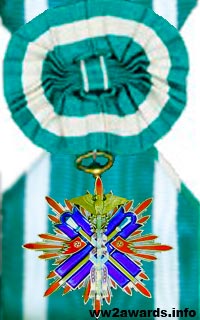
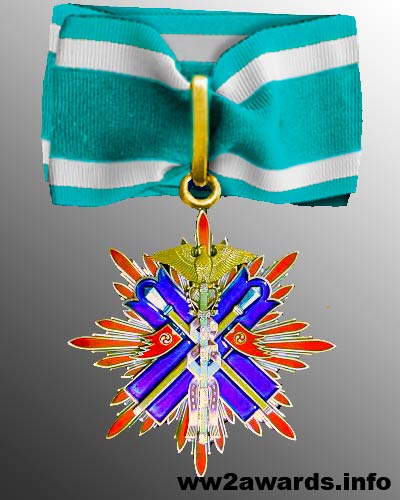
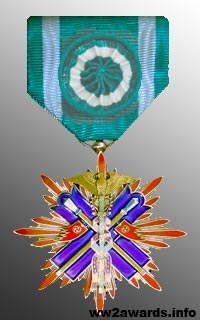
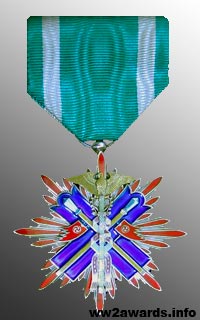
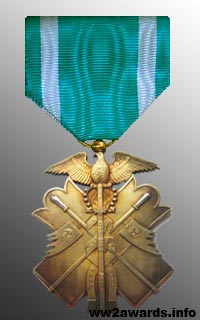
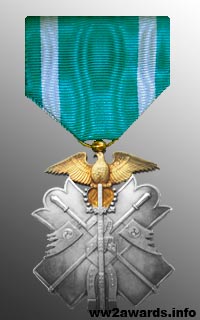
At the top of the award is a kite, with With outstretched wings, which, according to legend, helped Emperor Jimmu defeat his enemies in battle. The kite sits on two crossed samurai shields covered in blue enamel. Two crossed swords in yellow-enameled sheaths are superimposed on the shields. A halberd, entwined with horse harness, is vertically centered on the shield. Banners bearing the heraldic "Mitsutomoe" crest are at the right and left crossroads of the shields. The 1st-5th class award is superimposed on an eight-pointed star with 32 rays, enameled in red.
All badges were made of gilded silver; badges of classes 1-5 were also enameled. The ribbon of the Order of the Golden Kite is green, with longitudinal white stripes along the edges. The 1st class of the award is worn on a ribbon over the shoulder, 2nd and 3rd classes on a neck ribbon, and the remaining classes are worn on the left chest. The 1st and 2nd class awards also included an Order Star, which replicated the design of the order, but the rays of the star were enameled red and yellow. The 1st class star is worn on the left chest, and the 2nd class star on the left.