 Awards of
World War II
Awards of
World War IIThe Order of the Chrysanthemum is Japan's highest award. The Order of the Chrysanthemum on a wide ribbon was established by Emperor Meiji in 1876; On January 4, 1888, the second class of the Order on a chain was established.
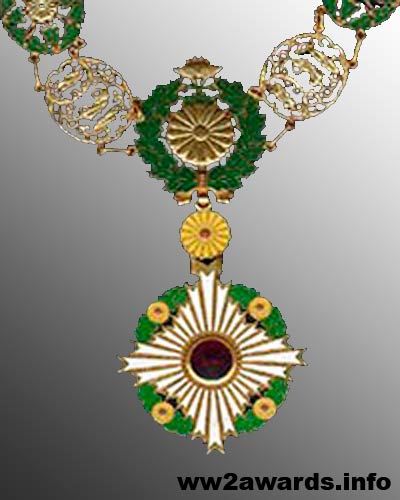
The Order of the Chrysanthemum on a chain is awarded to Japanese citizens only posthumously. An exception may be made for heads of state of foreign countries, to whom the award is presented as a special honor.
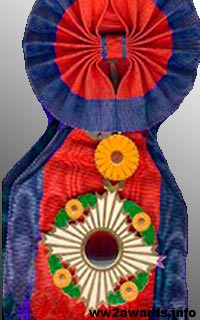
The Order of the Chrysanthemum on a ribbon is the highest award for Japanese citizens and may be awarded during their lifetime. Excluding members of the imperial family, only 21 people were awarded this honor during their lifetime, and 29 after their death.
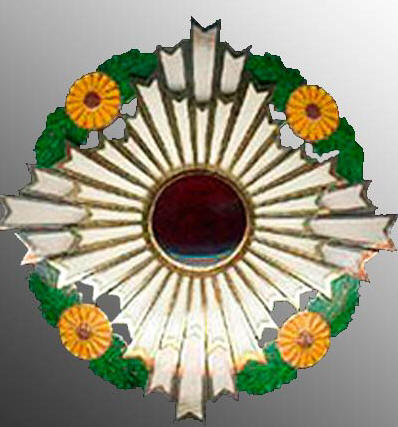
The award is a gilded silver cross with 32 diverging swallowtail-shaped rays of varying lengths. At the center of the award is a sun disk – a cabochon made of Japanese sippo enamel. Between the rays of the cross are chrysanthemum flowers covered in yellow enamel with green leaves. A large yellow chrysanthemum pendant and a ring for attaching the award to the ribbon or chain are attached to the top ray.
The star of the order is identical to the order itself, without the top chrysanthemum. It is ungilded and larger, measuring 90 mm compared to 60 mm for the chain-based order and 76 mm for the ribbon-based order. It is worn on the left chest.
The chain of the order is made of twelve gold links shaped like the characters "mei" and "ji," in honor of Emperor Meiji, who founded the award, and 13 medallions in the form of golden chrysanthemums surrounded by leaves covered in green enamel. All medallions are 27mm in size, with the exception of the lower one, to which the award is attached, which is 40mm in size.
The award ribbon is 115mm wide, made of red silk with an 18mm blue border along the edges, and is worn over the right shoulder.