 Awards of
World War II
Awards of
World War IIOne of the highest decorations in the Japanese Army, the "Bukose" (Military Merit Award), was awarded to soldiers who demonstrated exceptional valor and courage in combat.
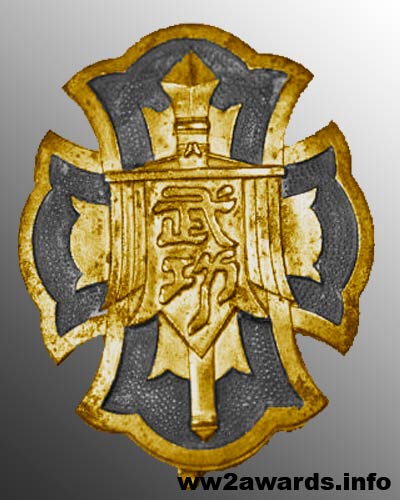
The award was established on December 7, 1944, in honor of the third anniversary of the attack on Pearl Harbor, in two classes: the Kou Award and the Otsu Award. Upon Japan's surrender, all award documents were ordered destroyed, so the exact number of awards presented is unknown. Research has shown that during the award's incomplete nine months of existence, at least 89 people received it, a significant portion of which went to fighter pilots defending Japan's skies from enemy bombers.
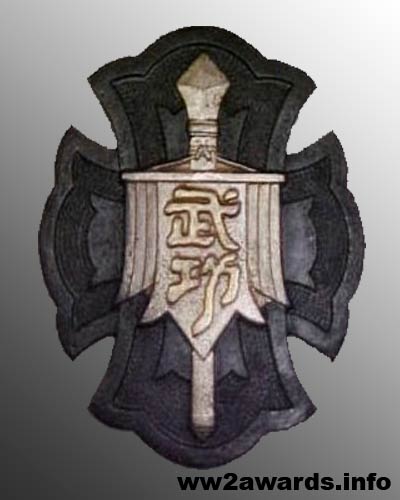
According to the award's regulations, it was awarded by order of the unit commander, immediately after the end of a battle in which a soldier had performed a heroic act. The establishment of this award was motivated by the need to boost soldiers' morale, while awarding other awards took a very long time. For example, the submission and approval of the Order of the Golden Kite took between one and a half and three years, which, in the bloody conditions of war, could easily have been a soldier's untimely end. Although there are known cases of soldiers being awarded this award for actions committed as early as 1941, and according to some sources, even in 1940.
The award itself is made of steel and shaped like two crossed samurai shields. A halberd and flag with an inscription (gold-plated for the 1st class and silver-plated for the 2nd class) in hieroglyphs meaning "For Military Merit" are superimposed in the center. On the reverse of the award are six hieroglyphs in two columns, which read "Army Badge for Military Merit."
The reverse of the 1st class badge is silver-plated, while the 2nd class badge is bronze-plated. A pin is provided on the reverse for attaching the award to clothing. The award is worn on the chest at the lower left. Both awards are the same size: 50 x 40 mm.