 Awards of
World War II
Awards of
World War IIThe Gold Medal for Military Valor, the highest award for valor, was established by King Victor Amadeus III on May 21, 1793, as an award for junior officers and soldiers who had performed outstanding acts of bravery on the battlefield.
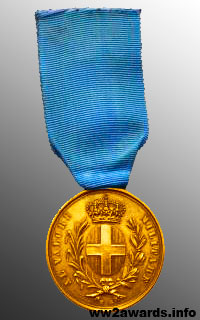
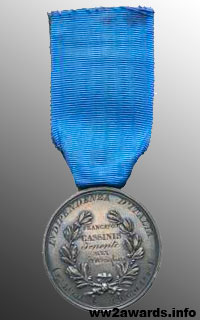
Before World War II, the medal had undergone abolition and reinstatement in the Italian awards system, as well as a number of changes to the original award statute. By 1939, it existed in the version reinstated in 1833 by King Charles Albert, who also added two junior versions of the award, silver and bronze.
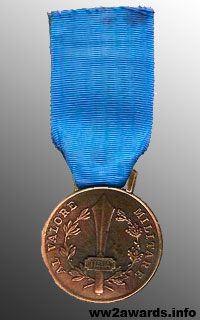
After the defeat of the Royalist forces in 1943, the award with a modified design was restored in the Italian Socialist Republic (Republic of Salo).
The Gold Medal "For Military Valor" is valued at the level of Italy's highest awards. According to the award's statute, even the most senior in rank must salute the recipient of the Gold Medal first.
The award was made in the form of a perfect circle, on the obverse of which was the Savoy shield, surrounded by laurel branches. Above the shield was a crown, with the inscription "AL VALORE MILITARE" (For Military Valor) around the circle. The award's reverse features the recipient's name in the center, surrounded by laurel branches, and the date of the heroic deed, encircled by a circle.
In the Republic of Salò, the obverse design was modified. The Savoy shield and crown were removed, replaced with a Roman short sword—a gladius—pointed upward, with the inscription "ITALY" on the crossguard.
The medal is attached to the award ribbon with a loop. The ribbon is made of blue silk moiré.
After Italy's defeat in the war, on June 2, 1946, the award was reinstated as the Medal for Military Valor of the Italian Republic, with the Republic's coat of arms on the obverse.