 Awards of
World War II
Awards of
World War IIThe Cross of Military Valor is an Italian military decoration established by King Victor Emmanuel III of Italy in 1922.
The award may be awarded to members of the armed forces, partisan fighters, as well as members of municipalities, provinces, and other citizens.
According to the award's statutes, it was intended "to reward those who took part in military operations, both on land, at sea, and in the air, and who demonstrated valor worthy of public praise." In addition, the award could be received in peacetime for acts of heroism, provided that the act of heroism was related to the goals assigned to the country's armed forces.
This award, like many other medals of merit, has two versions: the first was established in the Kingdom of Italy, and the second was awarded to the Italian Social Republic, a puppet state created in 1943 after the defeat of the royal troops.
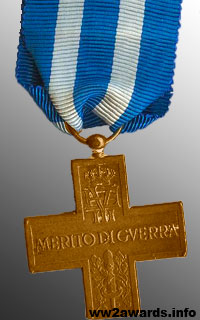
The award was made of copper, in the form of a Greek cross – the symbol of the Savoy royal dynasty. On the obverse, from the right to the left arm of the cross, is the inscription "MERITO DI GUERRA" (For Military Merit). On the upper arm is the king's monogram "V.E. III," surmounted by a crown, and on the lower arm is a vertical sword entwined with oak leaf branches.
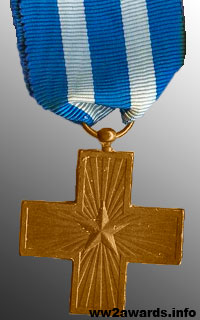
On the reverse of the award is a five-pointed star, with rays radiating from the star across the rest of the cross.
During World War II, the award underwent two modifications. In 1941, the inscription was replaced with "CROCE AL VALORE MILITARE" (Cross for Military Valor). The second change occurred in 1943, after the formation of the Italian Social Republic. The royal monogram and crown were removed from the top beam, replaced with the superimposed letters RI (Italian Republic), and the word "CROCE" (Cross) was removed from the inscription.
The award is attached to the ribbon with a ring. The ribbon of the Kingdom of Italy is a light blue silk moiré with two white stripes. The ribbon of the Cross of Military Valor of the Italian Republic is plain blue.
For valor displayed on the battlefield, a clasp in the form of a sword entwined with leaves was attached to the ribbon.