 Awards of
World War II
Awards of
World War IIThe award was established on September 1, 1939, for personnel of the armed forces, police, and, since 1943, civilians wounded in air raids. Those killed were awarded the highest "gold" class of this award posthumously, which was presented to their family members. The award's statute states "...as a badge of honor for all who risked their lives for the Motherland and were wounded or maimed."
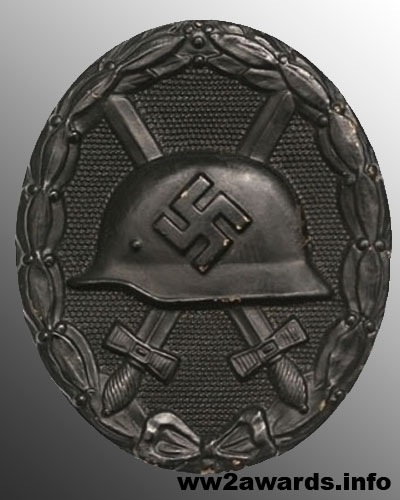
A similar wound award was quite common during the First World War. The new version of the award was developed based on it by adding a swastika to the image of a soldier's helmet. There are also some differences between this version of the award and the version approved during the Spanish Civil War. The latter was called the "Spanish" or Type 1 (model 1939) and lasted until 1942.
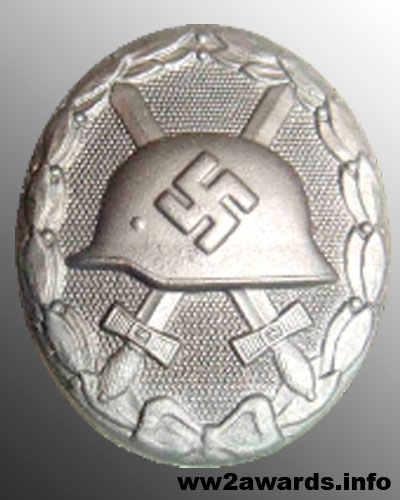
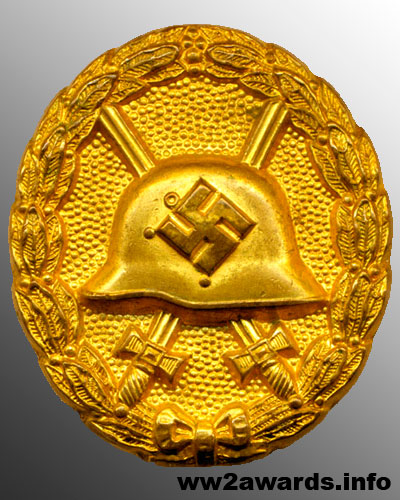
A few months after the start of Operation Fall Weiss, the Type 2 Wound Badge was instituted. This version of the award was very similar to the previous one: the same oval shape with an image of an M35 helmet with a swastika on it. Behind the helmet are crossed swords and a laurel wreath along the outline of the award with a ribbon woven into it. There were some variations in the sizes of the awards, but the 24 official manufacturers of this award adhered to standard sizes.
The black version of the award was stamped from sheet brass, while later versions were made of steel. The award has a hollow base with a pin for a needle. This version of the award rarely bears a maker's mark. Due to the declining quality of materials by the end of the war, these badges tended to rust.
The silver version of the award was initially made of silver-plated brass, and after 1942, of retouched zinc. The badge was awarded for three or four wounds or more serious injuries, such as loss of hearing, an arm, a leg, an eye, a head wound, or facial disfigurement.
The gold type of the award was awarded for five or more wounds, as well as for serious injuries such as complete loss of sight or severe damage to the musculoskeletal system. By 1945, due to deteriorating material quality, some "black" types of the award were dyed with the appropriate color and issued as silver and gold awards. In these cases, the reverse side of the badge was almost always hollow.
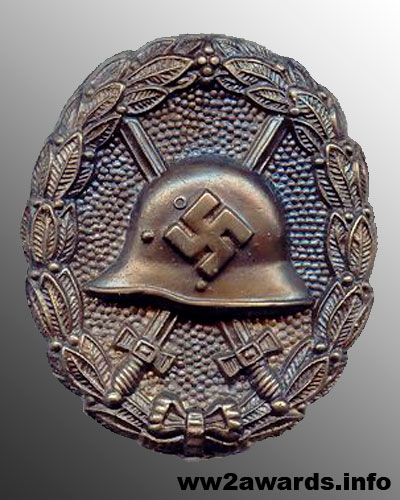
The Condor Legion, which fought in Spain from 1936 to 1939, did not receive a single wound or any other decoration during the entire war. After the Legion's return to Germany, a "Spanish" version of the wound badge was approved on May 22, 1939. The statute for this award stated: "...as a sign of distinction for German volunteers who were wounded in the fight against Bolshevism during the Spanish War of Liberation from 1936 to 1939." A total of 182 black badges and one silver badge were awarded after the war in Spain.
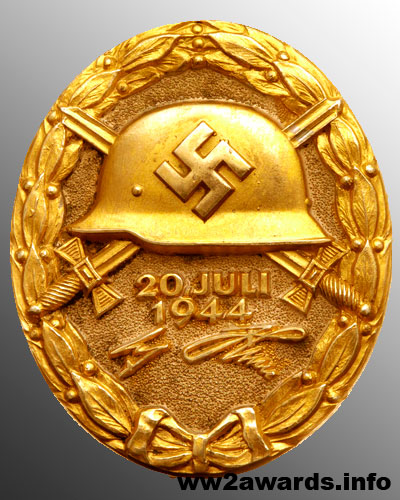
On July 20, 1944, the rarest type of the "For the wound" award was approved, and it was awarded to only a small group of German officers. The approval of this badge is connected with the famous assassination attempt on Hitler, and those nominated for this award were precisely those officers who suffered wounds of varying severity during that event. A total of 24 people. One person died at the scene, and three died in the hospital from their wounds.
Recipients wore the highest grade of the badge on the left breast pocket on all uniforms, below all other awards. Miniature badges were worn on civilian clothing. Recipients also privately commemorated the badge with a miniature on their dress bar.
A total of approximately 5,000,000 awards were issued.