 Awards of
World War II
Awards of
World War IIThe German military award for aircraft crew members serving as gunners, radio operators, and flight engineers was established on March 26, 1936.
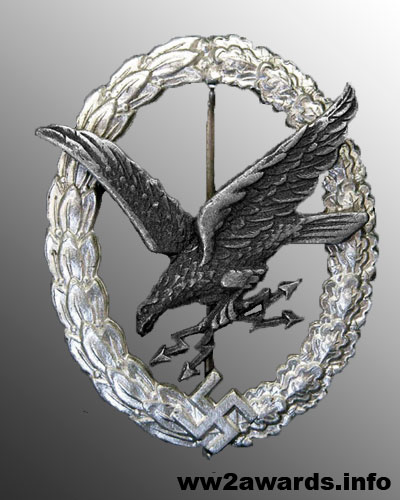
To receive this award, one had to complete training with the appropriate qualifications and fly at least five combat sorties. The badge could also be earned without fulfilling the combat mission requirement if a wound was sustained during one of them.
Later, in 1942, a separate badge was created for gunners and flight engineers, without the lightning bolts in the eagle's claws. Radio operators continued to receive the 1936 badge until the end of the war.
The award was initially made of aluminum; later, due to shortages, it was made of silver, tombac, nickel silver, and zinc. Like other badges, the award is designed as a wreath, with oak leaves on the right side and laurel leaves on the left. A brace is superimposed on the wreath at the bottom. In the center of the award is a diving eagle, the tips of its wings extending beyond the edge of the award. The eagle's claws bear two crossed lightning bolts (the lightning bolts were removed from the 1942 version for riflemen and flight engineers). The badge is silver-plated, with the eagle and lightning bolts oxidized.
The reverse of the award features a vertical pin for attaching the badge to clothing. The eagle may bear a manufacturer's mark. Notable manufacturers include: F.W. Assmann & Söhne, Lüdenscheid; C.E. Juncker, Berlin SW; JMME & Sohn, Berlin; W.Deumer, Lüdenscheid; Berg & Nolte, Lüdenscheid; Brüder Schneider AG, Vienna. The dimensions of the badge may vary slightly depending on the manufacturer. The wreath height ranges from 53.5 to 52 mm, the width from 43.5 to 40.3 mm, and the eagle's wingspan from 43.1 to 40.4 mm.
The riflemen's and radio operators' badge, like similar awards, is worn on the left breast pocket and is positioned below the Iron Cross First Class. The recipient was also entitled to wear a cloth award embroidered in the shape of the badge.