 Awards of
World War II
Awards of
World War IIThe award was established by Hermann Goering on January 19, 1935, for pilots who had the right to simultaneously wear the Pilot and Observer badges. On March 16, 1935, the highest level of distinction was established – the Pilot Observer Badge in gold with diamonds.
On July 31, 1944, an additional restriction was introduced: applicants for the award had to have been awarded the Pilot or Observer Badge at least one year previously.
The basis for the award was fulfilling the criteria for both junior awards: namely, the pilot had to have completed flight training, qualified as a military pilot, and also completed five combat missions as a reconnaissance, gunner, or spotter.
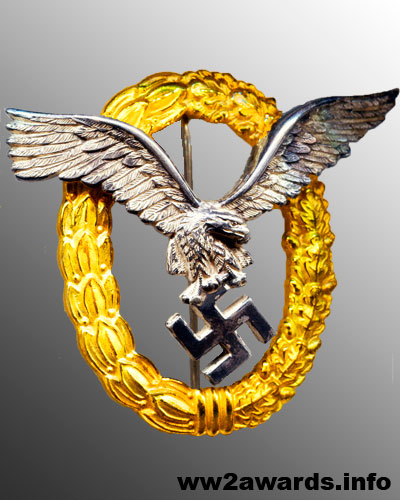
The award was a replica of the pilot's badge, with some modifications. Made of tombac, zinc, or aluminum, it was gilded (instead of silver-plated as in the Pilot Badge) over a wreath of oak (right) and laurel (left) leaves. In the center of the award is a flying eagle holding a swastika in its talons.
The reverse of the award features a vertical pin, and possibly a manufacturer's stamp. Known variants include CEJ and C.E. Juncker.
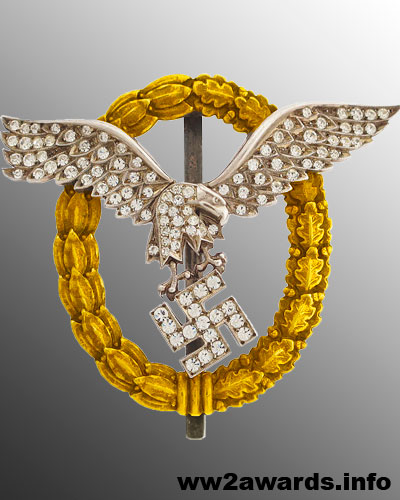
The Pilot Observer Badge with diamonds was an award for exceptional service to the Luftwaffe and was presented personally by Hermann Göring. The award's wreath was made of 14-karat gold (585 fineness, in the metric system). The eagle was slightly larger and made of platinum. The badge was set with 104 small diamonds: 36 and 31 on the right and left wings, 19 on the eagle's body, and 18 on the brace. A replica of the award, made of gilded silver and featuring rhinestones instead of diamonds, was also issued for everyday wear. In the event of the death of the recipient, the diamond-plated badge was to be returned to the Luftwaffe, while the rhinestone-plated replica remained with the deceased's family. A total of 60 awards were made, 34 of which were awarded. The Pilot Observer badge, like others, is worn on the left breast pocket of the jacket and is positioned below the Iron Cross First Class.