 Awards of
World War II
Awards of
World War IIThe Glider Pilot Badge, established on December 16, 1940, as a Third Reich award for Luftwaffe pilots who completed flight training and qualified as glider pilots.
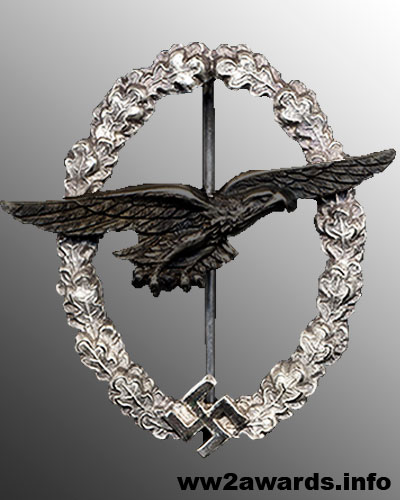
The original idea for this badge came from the commander of the 7th Air Division, Lieutenant General Richard Putzer. The Air Ministry, headed by Field Marshal Milch, approved this initiative and announced a design competition. The design by the renowned Berlin artist Ernst Peckhaus won the competition, after which a trial batch of badges was commissioned from W.E. Juncker.
The badge is designed in the form of an oval wreath of oak leaves, with a swastika superimposed on the lower part. In the center of the award is a gliding eagle, attached to the wreath with two rivets, although variants with a soldered eagle are also known. The wreath is silver-plated, the eagle is silver-plated and oxidized. On the reverse of the award is a vertical pin for attaching to clothing and the maker's mark. Known manufacturers: C.E. Juncker; W.Deumer, Lüdenscheid; Brüder Schneider AG, Vienna; OM.
The dimensions of the award are: width 42 mm, height 55 mm, and the eagle's wingspan is 53 mm. A cloth version of the award, embroidered with silver thread, is also available for everyday wear.
The Glider Pilot's badge is worn on the left breast pocket of the jacket, and if the Iron Cross 1st Class is worn, it is placed underneath it.