 Awards of
World War II
Awards of
World War IIThe award was established on September 1, 1937, as a distinctive badge for parachute brigades of Wehrmacht infantry units. Eligibility required completing five or more jumps and passing a qualification test.
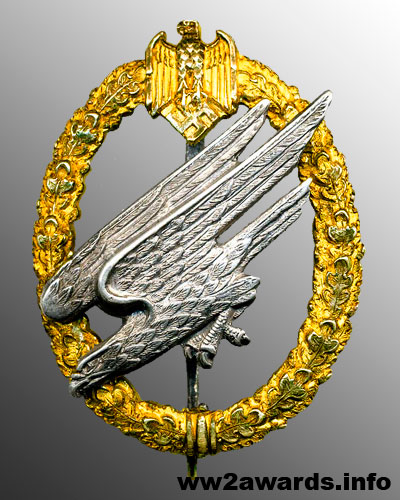
The badge is designed as a gilded wreath of oak leaves, entwined at the bottom with a ribbon. At the top of the wreath is an eagle with folded wings, holding a swastika in its talons. In the center is a silver-plated, oxidized attack eagle, crafted as a separate element, attached to the wreath with two small pins. The reverse of the award has a vertical pin for attaching to clothing. All elements of the badge are executed with a high level of quality, featuring a level of detail not found in later wartime badges.
The award was discontinued after the parachute units were transferred to the German Air Force in 1938. Therefore, this badge is not a wartime badge; it existed for just over a year and is therefore very rare.
The award was presented in a blue leather-covered box, with the name printed on the front in gold Gothic letters.
The award was accompanied by the usual set of documents (an entry in a soldier's book) indicating the recipient's name, unit name, signature, and stamp.
This badge, like others similar to it, is worn on the left side immediately below the Iron Cross 1st Class or similar award.