 Awards of
World War II
Awards of
World War IIThe silver chest badge was established on December 20, 1939 by order of General Brauchitsch as an award for personnel of tank units of German motorized units. On June 6, 1940, the award was supplemented with a bronze chest badge.
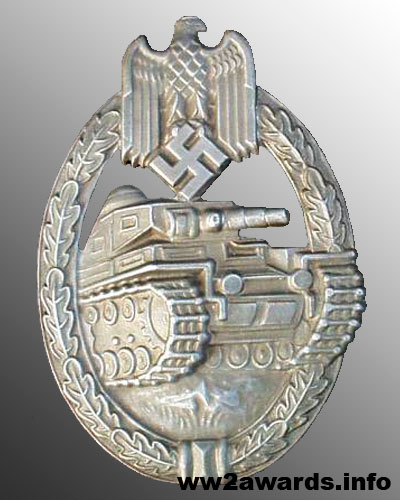
According to regulations, the silver version of the award was awarded to the crews of armored combat vehicles, and the bronze version was intended for paratroopers and medical personnel traveling in armored vehicles.
The conditions for receiving the badge were as follows:
- Participation in three or more separate combat episodes;
- Being wounded during a combat operation;
- Receipt of any other award for bravery displayed during the operation.
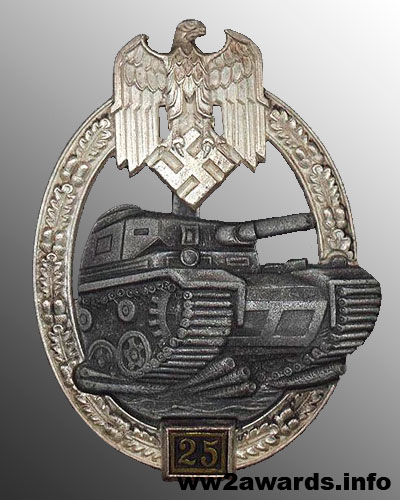
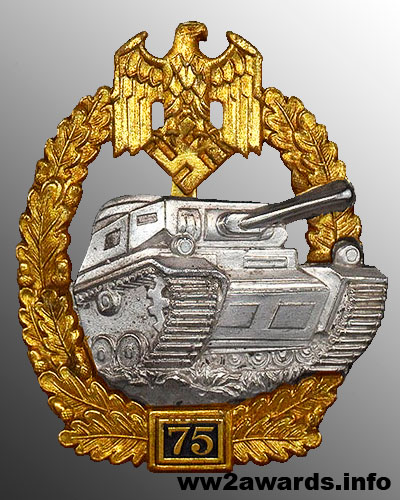
As the war progressed, it became clear that the existing badge was insufficient to recognize the growing number of experienced tank crews, and in June 1943, four new classes of awards were introduced for participation in 25, 50, 75, and 100 attacks.
The Tank Attack Badge depicts a PzKpfw IV tank moving from left to right, framed by a wreath Five oak leaves on each side, tied with a ribbon at the bottom. The tank's left track is covered by one of the oak leaves on the right. Above is the military symbol of the Third Reich—an eagle clutching a swastika in its talons.
Badges for 25, 50, 75, and 100 attacks have a plaque with the number of attacks at the bottom of the wreath. In addition, on the 25 and 50 attack badges, the tank is oxidized. On the 75 and 100 attack badges, the wreath, eagle, and swastika are gilded, and the oak leaves are larger.
The reverse of the award has a vertical pin for attaching to clothing. The badge is worn on the left side, immediately below the Iron Cross 1st Class or equivalent award.
Early badges were very well crafted, made of bronze and silver. In later badges, the silver was replaced with silver-plated zinc, and the bronze with tombac, and the craftsmanship also deteriorated.
The award was presented in a paper envelope. The award name was printed in Gothic letters on the front of the envelope, and the manufacturer's stamp was affixed on the back. The award was accompanied by the usual set of documents (an entry in a soldier's book) indicating the recipient's name, unit name, signature, and stamp.